Williamsburg Food Tour, Brooklyn: What to Actually Expect
Is a Williamsburg food tour worth it, and is Smorgasburg open year-round?
Williamsburg rewards a guided or self-led food crawl along Bedford Avenue, but Smorgasburg, its outdoor food market, runs seasonally, roughly April to October, and closes for winter. Prices here have risen with gentrification and now often match or exceed Manhattan, so this is not a budget alternative.
Getting to Williamsburg and orienting yourself
Williamsburg sits just across the East River from Manhattan, and getting there is refreshingly simple: the L train runs directly under the neighborhood’s main commercial stretch, with Bedford Avenue the stop almost everyone uses. From Union Square in Manhattan, the ride takes roughly 15-20 minutes — closer to a short subway hop than a cross-borough trek, which is part of why the neighborhood fills up on weekends.
Once you’re above ground, Bedford Avenue is your spine. The strip most visitors care about — the one dense with restaurants, coffee shops, vintage stores and bars — runs roughly 30-40 minutes end to end on foot at an unhurried pace. That’s a useful number to keep in mind: you don’t need a full day of walking to cover the neighborhood’s food scene, and a half-day outing is realistic if you’re focused.
For a look at the Williamsburg destination page with a fuller neighborhood overview, or to compare it against Brooklyn as a whole, those pages are a useful starting point before you plan a food-focused visit.
What “food tour” means in Williamsburg
A Williamsburg food tour can mean two quite different things, and it’s worth knowing which one you’re planning for.
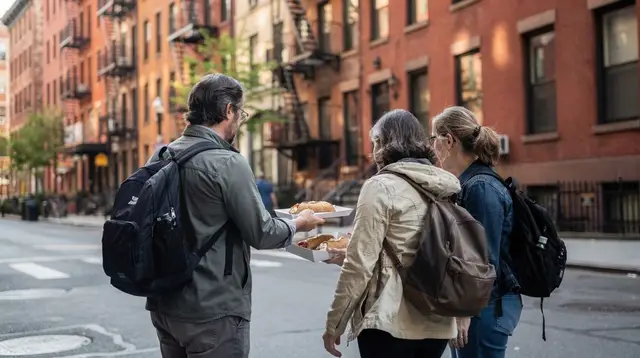
The first is a guided walking food tour, where a local guide leads a small group between four to six stops — often a mix of a pizza slice, a bagel or bakery item, a taco or dumpling stand, and something distinctly Brooklyn, like a craft chocolate shop or an old-school Italian deli. These tours typically run two to three hours, include tastings at each stop, and add historical or neighborhood context you wouldn’t get eating alone. Several such tours cover Williamsburg specifically, sometimes paired with shopping stops or extended into nearby Brooklyn neighborhoods.
The second is Smorgasburg, the open-air food market that many visitors associate with Williamsburg first and foremost. It’s not a tour at all — it’s a market you wander at your own pace, sampling from dozens of vendors. Both approaches work, and they’re not mutually exclusive: plenty of visitors do a guided tour on one day and a self-directed Smorgasburg visit on another, since Smorgasburg’s vendor lineup changes and rewards unstructured browsing.
a guided food and shopping walk through Williamsburg is a solid way to get oriented on a first visit, pairing tastings with a sense of where the neighborhood’s better shops and side streets actually are.
Smorgasburg: the market everyone asks about, and its real limits
Smorgasburg is Williamsburg’s best-known food attraction, and it’s also the single most misunderstood one. It is an outdoor, open-air market, and outdoor markets in New York close for winter — Smorgasburg is no exception. It typically runs from April through October, weather and vendor participation depending, and is closed for the winter months. If your trip falls between November and March, do not build your itinerary around it: it will not be running, full stop, regardless of what an outdated blog post or old photo might suggest.
When it is running, Smorgasburg brings together dozens of food vendors under one roof-free market setup, ranging from Brooklyn-based bakeries and ice cream makers to more ambitious global street food. It’s genuinely one of the better ways to sample a wide range of Brooklyn food culture in a single visit, but treat “seasonal” as a hard constraint, not a suggestion, when you’re planning dates.
Because the market itself changes location and schedule from season to season, and this guide won’t guess at specifics that shift year to year, check current dates and the market’s exact site before you build a day around it. What doesn’t change is the general window: spring through fall, not winter.
Bedford Avenue: the everyday food scene
Even outside of Smorgasburg’s season, Bedford Avenue and the streets branching off it carry Williamsburg’s food identity year-round. This is where you’ll find the neighborhood’s pizza spots, coffee shops, bagel counters, natural wine bars, and a genuinely wide range of sit-down restaurants, from long-standing Italian-American spots to newer, design-forward openings.
Walking the full stretch takes 30-40 minutes without stopping, which makes it easy to treat as a loose spine: start at one end, wander into side streets as something catches your eye, and finish at the other end a few hours later having eaten more than you planned. This is also the terrain a guided food tour typically works — moving between fixed stops along or just off Bedford Avenue, rather than covering the whole neighborhood in one sweep.
For a tour built specifically around Italian-American food culture, which runs deep in this part of Brooklyn, an Italian American food tour through Williamsburg covers some of the neighborhood’s older, family-run spots alongside newer additions.
The gentrification price reality
It needs to be said plainly: Williamsburg is not a budget alternative to Manhattan dining anymore. A decade or more of rapid gentrification has reshaped the neighborhood’s retail and restaurant landscape, and prices have climbed accordingly. A sit-down dinner, a specialty coffee, or a boutique bakery item in Williamsburg today can easily match — or exceed — the equivalent in parts of Manhattan.
This matters for planning because visitors sometimes head to Brooklyn expecting lower prices simply because it’s “outside Manhattan.” That assumption doesn’t hold in Williamsburg specifically. If your priority is genuinely cheaper eating, other Brooklyn or Queens neighborhoods with less tourist and gentrification pressure will serve that goal better than Williamsburg will. Come here for the food scene and the neighborhood’s particular mix of old Brooklyn and new money — not for savings.
For a broader sense of what things cost across the city and how Williamsburg compares, the New York City budget planning guide lays out typical price ranges by category.
Tax and tipping: two rules that don’t change block to block
Two cost rules apply everywhere in Williamsburg exactly as they do everywhere else in New York City, and both catch first-time visitors off guard.
Sales tax is 8.875%, and it is never included in a posted price. Whether you’re buying a $12 lunch special or paying for a sit-down dinner, the number on the menu is not the number on your receipt — expect roughly an extra 9% added at checkout.
Tipping conventions split by service style. At Smorgasburg or any counter-service food stall, where you order, pay, and carry your own food to a table or bench, no tip is expected — treat it like a food-truck or fast-casual transaction. At a sit-down restaurant with table service, the norm is the same as anywhere else in the city: 18-20% of the pre-tax subtotal, calculated before the sales tax is added, not after. Mixing these two up in either direction is a common visitor mistake — over-tipping a market stall, or under-tipping a full-service dinner.
For more detail on how tipping norms work across the city more broadly, see the tipping in the USA guide and the related note on how NYC sales tax interacts with sticker prices.
Choosing between a guided tour and going it alone
A guided food tour earns its cost in a few specific ways: it removes the guesswork of which of dozens of similar-looking restaurants is actually worth your calories, it adds context about the neighborhood’s Italian, Jewish, Puerto Rican and more recent waves of history that shaped its food scene, and it keeps a small group moving efficiently through four to six stops in two to three hours rather than wandering and second-guessing.
Options range from tours focused tightly on Williamsburg to ones that fold in neighboring Brooklyn areas. a food tour focused on Brooklyn’s mom-and-pop culinary gems leans into smaller, family-run spots rather than the newer, more Instagrammed openings, which suits visitors who want the neighborhood’s older character alongside its current reputation. For something with a more playful framing built around street food specifically, a street food-focused tour through Brooklyn moves briskly between casual, walk-and-eat stops.
If you’d rather cover Williamsburg’s food scene alongside its broader culture and history in one outing, a food and culture tour through the heart of Brooklyn blends tastings with neighborhood storytelling, useful if this is your only stop in Brooklyn on the trip.
Going it alone works well too, especially if Smorgasburg is in season — the market essentially does the curation for you, letting you sample from dozens of vendors without booking anything. A hybrid approach — a guided tour on your first Brooklyn day, self-directed grazing on a return visit — is common among visitors staying more than a couple of days.
Pairing Williamsburg with the rest of Brooklyn
Williamsburg rarely needs to be a full day on its own, which makes it easy to combine with neighboring areas. Its waterfront connects, on foot or by a short bus or bike ride, toward DUMBO and the Brooklyn Bridge, and the L train puts you back in Manhattan in under 20 minutes if you want to split a day between the two.
If nightlife and street art are more your interest than food specifically, the Williamsburg street art and nightlife tour covers the neighborhood’s other well-known draw. Visitors building a longer, more active day might also look at the Brooklyn waterfront bike tour, which threads along the river past Williamsburg toward DUMBO. For a first-time, realistic sense of what fits into a single Brooklyn day, the Brooklyn in one day realistic itinerary is a useful sanity check against overplanning.
Museum-inclined visitors passing through on a weekend should note the Brooklyn Museum’s First Saturdays program, a free monthly evening event that pairs reasonably well with an earlier Williamsburg food stop, given the two neighborhoods sit a short subway or car ride apart.
For those planning a longer, food-centered Brooklyn and Queens stretch, the five-day food neighborhoods itinerary situates Williamsburg within a broader multi-day plan rather than treating it as an isolated afternoon.
How Williamsburg compares to other NYC food neighborhoods
Williamsburg isn’t the only New York neighborhood built around a walkable food scene, and knowing how it stacks up helps set expectations before you commit a half-day to it. Compared with the dense, multi-generational food streets of Chinatown and Little Italy in Manhattan, Williamsburg feels newer and more curated — its food identity is largely a product of the last fifteen to twenty years rather than a century of continuous immigrant settlement. That doesn’t make it less worthwhile, but it does mean the character is different: polished storefronts and design-forward openings rather than decades-old family counters, though pockets of the latter still exist along and off Bedford Avenue.
Queens offers a genuinely different comparison. Neighborhoods like the ones covered in the Queens food tour of Jackson Heights trade Williamsburg’s polish for a wider spread of first-generation immigrant cooking at prices that haven’t been pushed upward by the same gentrification pressure. If budget and authenticity matter more to you than atmosphere and photogenic settings, Queens is worth the extra subway time. Uptown, Harlem’s soul food scene offers yet another contrast — a food culture rooted in a specific community history rather than a recently arrived one.
None of this makes Williamsburg the wrong choice; it simply means the neighborhood is better understood as one flavor of New York eating among several, rather than a default stand-in for “Brooklyn food.” For a broader, city-wide take on how to eat well without falling into tourist-priced traps anywhere in New York, the guide to eating in NYC without the tourist trap applies the same logic across boroughs, Williamsburg included.
If your Brooklyn day has room for more than food, a couple of add-ons pair naturally with a Williamsburg visit. a Brooklyn waterfront bike tour through the borough’s parks covers some of the same riverside terrain on two wheels rather than on foot, useful if you’d rather burn off a few of the calories you just ate than walk them off. And if a weekend visit happens to land on a First Saturday, the Brooklyn Museum’s free First Saturdays evening is close enough by subway to fold into the same day without much backtracking.
Practical notes for the day of
Arrive with an empty stomach and a loose plan rather than a rigid list — Williamsburg’s food scene rewards wandering into whatever line looks shortest or whatever smell is strongest, more than it rewards a spreadsheet. If you’re going for Smorgasburg specifically, double-check it’s in season (April-October) before you build your day around it; outside that window, plan around Bedford Avenue’s year-round restaurants and shops instead.
Bring a card or phone for tap payment — most vendors, market stalls included, accept contactless payment, though a few smaller cash-only stalls still turn up, particularly at Smorgasburg. And budget for prices that track closer to Manhattan than to a “cheaper borough” assumption; that adjustment alone will keep your day’s spending from surprising you.
| Consideration | What to know |
|---|---|
| Getting there | L train to Bedford Avenue, ~15-20 minutes from Union Square |
| Walking distance | Bedford Avenue end to end: 30-40 minutes on foot |
| Smorgasburg season | Roughly April-October; closed in winter |
| Sales tax | 8.875%, added at checkout, never in the displayed price |
| Tipping at market stalls | Not expected |
| Tipping at sit-down restaurants | 18-20% of the pre-tax bill, standard NYC norm |
| Price level vs. Manhattan | Comparable or higher in many cases, due to gentrification |
Williamsburg’s food scene is genuinely worth the short ride from Manhattan, but it rewards visitors who come with accurate expectations: check the season if Smorgasburg is the draw, expect Manhattan-level prices rather than bargain-borough ones, and know which of the neighborhood’s food experiences — guided tour, market wander, or a self-led Bedford Avenue crawl — actually matches how you like to eat while travelling.
Food Tours & Tastings
Verified deep-linked GetYourGuide tours. Book through these links and we earn a small commission at no cost to you.
GetYourGuide does not provide a product photo for this activity — the image shows the meeting point, photographed by us.