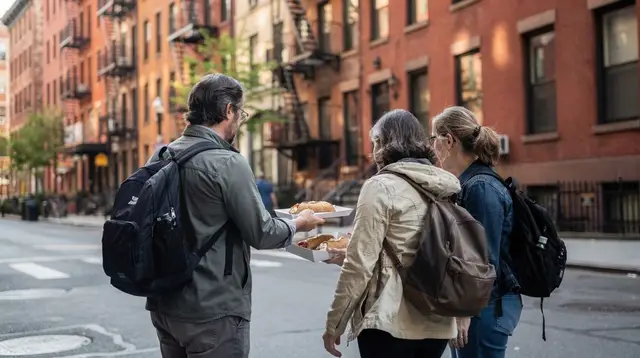
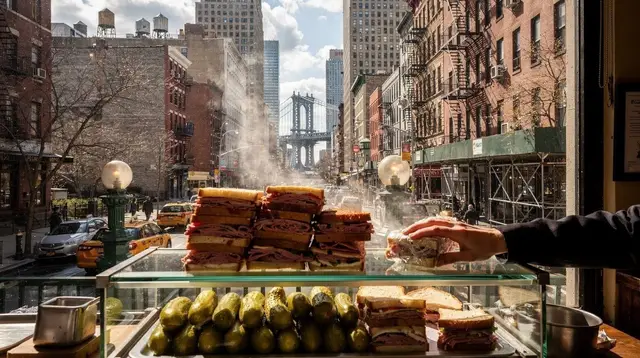
A Chinatown and Little Italy Food Walk, Block by Block
What is the difference between a Chinatown and Little Italy food walk?
It is really two neighborhoods on either side of Canal Street: a large, still-residential Chinatown with dense, affordable food stalls and bakeries, and a much smaller Little Italy, now reduced mostly to a few restaurant-lined blocks of Mulberry Street. Most self-guided or booked walks cross Canal Street to sample both in a single afternoon.
Two Neighborhoods, One Walk
Chinatown and Little Italy sit side by side in Lower Manhattan, close enough that most visitors treat them as a single stop, but they are genuinely different places with different histories, different sizes, and very different food. Understanding that difference before you set out makes the walk more interesting, and it also sets realistic expectations: one of these neighborhoods is large and lived-in, the other is now mostly a handful of restaurant blocks.
Chinatown is one of the largest and oldest Chinese communities in the United States, and it remains an active residential neighborhood stretching across a wide swath of Lower Manhattan, roughly bounded by Canal Street to the north, the Bowery to the east, and reaching down toward the courthouses near Foley Square. People live here, shop for groceries here, and go to work here; the food you find reflects that everyday life as much as it reflects tourism. Little Italy, by contrast, has shrunk dramatically over the past several decades as Chinatown’s population and footprint expanded.
What remains of it today is concentrated almost entirely on Mulberry Street between Canal and Broome Streets, a few blocks of Italian restaurants, cafes and pastry shops that function largely as a dining destination rather than a residential Italian enclave. It is worth saying plainly: Little Italy is not, in any current demographic or geographic sense, an Italian neighborhood the way it may have been a century ago. It is a small commercial strip, surrounded on nearly every side by Chinatown.
Canal Street is the rough, unofficial dividing line most people use between the two, though the transition on the ground is gradual rather than a hard edge. Walking north from Canal onto Mulberry Street, the shift in restaurant signage, menus and outdoor seating from Chinese to Italian happens over a block or two, not instantly. This guide treats the two as a single connected walk, crossing that loose border more than once, because that is how most people actually experience the area on foot.
Starting Point and Orientation
The most convenient starting point for this walk is the Canal Street subway station, a major transit hub served by the N, Q, R and W lines, the 6 train, and the J and Z lines. From any of its exits, Mulberry Street and the edge of Chinatown’s main commercial blocks are within a five-minute walk. Because Canal Street itself is one of the busiest, most chaotic streets in Lower Manhattan, lined with souvenir stalls and street vendors, it also works well as a mental landmark: everything north of it, concentrated on Mulberry Street, is Little Italy’s remaining core, and everything south and east of it is Chinatown proper, spreading for many more blocks than most first-time visitors expect.
If you are coming from other parts of the city, this walk pairs naturally with a stop in SoHo, whose cast-iron shopping streets sit just north of Little Italy, or with a broader loop through Lower Manhattan toward the Financial District. Travelers based in Manhattan generally find this one of the easiest food walks to fit into a half-day, since it requires no additional transit once you arrive.
Walking Chinatown: A Working Neighborhood, Not a Theme Park
Chinatown rewards wandering more than following a strict route. A useful loop covers Mott Street, Mulberry Street’s southern extension below Canal, Doyers Street (a short, sharply bent alley with its own history), and the produce and fish markets along Canal and Grand Streets. This is where the neighborhood’s daily life is most visible: fishmongers laying out the morning catch on ice, bakeries with trays of egg tarts and barbecue pork buns coming out of the oven, and noodle shops with hand-pulled noodles made in full view of the sidewalk.
Food here spans far more than any single regional Chinese cuisine. Depending on which block you are on, you will find Cantonese barbecue, Hong Kong-style bakeries, Fuzhou hand-pulled noodles, Sichuan hot pot, and Vietnamese and other Southeast Asian influences that have settled into the neighborhood over time.
Dumplings, whether pan-fried, steamed or in soup, are a reliable anchor point for a food walk, since small dumpling counters are common, inexpensive, and quick, letting you sample several without committing to a full sit-down meal. For a more structured, hands-on introduction to this particular dish, a dedicated dumpling-making workshop is a good complement to simply eating your way down the block.
One practical point worth planning around: a number of smaller Chinatown businesses, particularly bakeries, noodle counters and some restaurants, post menus only in Chinese, or in Chinese with limited English translation. This is not unusual and is not a barrier if you are prepared for it. Having a photo of the dish you are looking for, saved from a search or sent by a friend who recommended the spot, is a simple and effective way to order without a shared language.
Pointing at what another customer is eating, or at the item in a display case, works just as well. This is one of the small, real textures of Chinatown that separates it from more tourist-oriented food streets, and it is part of what makes it worth visiting rather than a smaller, curated version of it.
Cash is still commonly preferred, and sometimes required, at smaller counters and bakeries, even as card and mobile payment acceptance has grown across the neighborhood. Carrying a modest amount of small bills avoids any awkward moment at a counter that cannot run a card for a three-dollar bun.
Crossing Into Little Italy: Mulberry Street and Its Limits
Heading north across Canal Street onto Mulberry Street, the character of the block changes over a short distance. Red, white and green awnings replace Chinese signage, outdoor seating spills further onto the sidewalk, and the smell shifts from steamed buns to garlic and tomato sauce. This stretch, roughly from Canal Street up to Broome Street, is what remains of Little Italy as a distinct place, and it is genuinely worth walking, but it is important to see it for what it is: a small, dense strip of Italian restaurants, cafes and a handful of specialty shops, not the extensive Italian-American neighborhood that once occupied a much larger footprint across these blocks.
That contraction happened gradually over the twentieth century, as waves of immigration shifted and Chinatown’s population grew and expanded outward. What is left today functions largely as a dining and pastry destination: classic red-sauce restaurants with veal and pasta dishes, espresso bars, and bakeries known for cannoli and other Italian pastries.
A short stop at one of Mulberry Street’s cafes for espresso and a pastry is a natural midpoint on this walk, whether or not you plan a full meal here. Because this stretch is compact, it does not take long to see the whole of it, and most visitors are pleasantly surprised by how quickly the walk moves from one food culture into the next and, often, back again, since Chinese and Italian businesses now sit within a block or two of each other along parts of Mulberry Street itself.
For visitors interested in the neighborhood’s older reputation and folklore, including its connections to organized crime history that shaped its portrayal in film and popular culture, a dedicated Little Italy history walking tour digs into that layer in more depth than a food-focused walk alone.
Costs, Tax and Tipping on This Walk
New York City sales tax is 8.875 percent, and it is added at the register on top of the price shown on a menu or sign; it is never included in the sticker price, so a five-dollar item becomes a little over five dollars and forty cents at checkout. This applies at every stop on this walk, from a Chinatown bakery counter to a Little Italy trattoria.
Tipping practices differ noticeably between the two food styles you will encounter. At small Chinatown counters, takeout dumpling stalls, and bakeries where you order at a window and often eat standing or walking, tipping is not systematically expected the way it is at a table-service restaurant. Many of these spots do not have a tip jar at all, and leaving a little extra is a nice gesture rather than an obligation. At any restaurant with table service, including nearly every sit-down spot on Mulberry Street in Little Italy, the standard New York norm applies: 18 to 20 percent of the pre-tax bill, calculated before the sales tax is added, is the expected tip for adequate to good service.
A rough sense of costs for this walk: individual dumplings or buns from a Chinatown counter typically run one to three dollars each; a full noodle or rice dish at a casual Chinatown restaurant runs roughly ten to fifteen dollars; a sit-down pasta or veal entree in Little Italy runs closer to twenty-five to forty dollars before tax and tip, in line with typical Manhattan sit-down dinner pricing. Building a walk around several small Chinatown tastings plus one Little Italy sit-down course, rather than two full meals, is usually the better way to sample both without overspending or over-eating.
Doing the Walk on Your Own vs. Booking a Guided Tour
A self-guided version of this walk costs nothing beyond what you spend on food, and the route described above is straightforward enough to follow without help: Canal Street station as a starting point, a loop through Chinatown’s core blocks, then north across Canal onto Mulberry Street for Little Italy’s remaining strip. The tradeoff is that you will likely miss context on what you are eating, may not know which counters are genuinely well-regarded versus simply well-located for tourist foot traffic, and will need to navigate the language and menu gaps in Chinatown on your own.
A guided food walk solves those problems directly. A local guide typically leads a small group between four and eight tasting stops across both neighborhoods, choosing counters and restaurants based on reputation rather than storefront visibility, and providing running commentary on the history of both areas, including exactly the kind of nuance about Little Italy’s real size that is easy to miss on your own.
a small-group walking tour through Chinatown and Little Italy with multiple food tastings is a solid starting option for a first visit, generally running a couple of hours and covering both sides of Canal Street. For those with a tighter midday schedule, a lunchtime-focused version of the same route compresses the tastings into a shorter window built around the lunch hour. If you would rather experience the neighborhoods after dark, when the pace and lighting change considerably, an evening food and storytelling walk through both areas pairs tastings with more narrative history once the daytime market crowds have thinned out.
Whichever approach you choose, arriving hungry and pacing yourself across several smaller tastings, rather than one large meal, is the most effective way to actually sample the range of food packed into these few blocks.
Fitting This Walk Into a Wider Visit
This food walk works well as a half-day addition to a broader exploration of Lower Manhattan. It sits within easy walking distance of SoHo’s shopping streets to the north and the Financial District to the south, and it can be combined with a Financial District walking tour or a stroll through Greenwich Village later the same day.
Visitors building a broader food-focused day in the city sometimes pair this walk with a separate outing to Greenwich Village’s food scene, or, on another day entirely, venture further afield to Harlem’s soul food corridor or the more residential, less tourist-oriented food streets of Jackson Heights in Queens, both of which offer a useful contrast to the density of Chinatown and Little Italy.
For a first full day in New York City, this walk slots naturally into a broader one-day Manhattan itinerary, typically scheduled for late morning or early afternoon so that lunch happens organically along the route.
However you plan the rest of your day, getting to and from the area is simple: the Canal Street station’s cluster of lines connects easily to the rest of the subway system, and general fare mechanics are covered in the guide to OMNY and MetroCard fares if you are still deciding how to pay for rides. Broader food-tour options across things to do in Chinatown and SoHo and the citywide food tours category are worth browsing if this walk leaves you wanting more.
Chinatown and Little Italy Food Walk: Frequently Asked Questions
Is Little Italy still an Italian neighborhood?
Not in any meaningful demographic sense. Decades of Chinatown’s expansion have reduced Little Italy to a small commercial strip, mainly Mulberry Street between Canal and Broome, lined with Italian restaurants and cafes. Very few Italian residents remain in the surrounding blocks, which are now part of Chinatown.
Where exactly is the border between Chinatown and Little Italy?
There is no official line, but Canal Street is the commonly used approximate boundary, with Mulberry Street running north from around Canal as the surviving core of Little Italy. In practice the two areas blend into each other over a block or two rather than switching abruptly.
Do I need cash for the food stalls in Chinatown?
Many small counters and bakeries in Chinatown are cash-only or strongly prefer cash, though this has been changing. Carrying some small bills makes the walk smoother, since not every vendor accepts cards or mobile payments.
Is tipping expected at Chinatown food counters?
Not in the same way as at a sit-down restaurant. At small takeout counters, bakeries and dumpling stalls, tipping is appreciated but not systematically expected. At any Little Italy restaurant with table service, the normal New York standard of 18 to 20 percent of the pre-tax bill applies.
What if a menu is only in Chinese?
It happens at a number of Chinatown spots, especially smaller bakeries and noodle counters. Having a photo of the dish you want, from a search or a friend’s recommendation, is a practical way to order without a shared language, and pointing at what other customers are eating works too.
How do I get to Chinatown and Little Italy by subway?
The Canal Street station is the main access point and is served by the N, Q, R, W, 6, J and Z lines, putting it within a short walk of both Mulberry Street and the heart of Chinatown.
How long does a Chinatown and Little Italy food walk take?
A relaxed self-guided walk covering both areas, with several food stops, typically runs two to three hours. Guided tours booked in advance usually run two to three hours as well and are paced to fit in multiple tastings without rushing.
Food Tours & Tastings
Verified deep-linked GetYourGuide tours. Book through these links and we earn a small commission at no cost to you.
GetYourGuide does not provide a product photo for this activity — the image shows the meeting point, photographed by us.