Jackson Heights Food Tour: Queens' Global Food Neighborhood
Is Jackson Heights worth a food tour, and how do I get there?
Yes — Jackson Heights is one of the most ethnically diverse neighborhoods anywhere, with dense clusters of South Asian, Latin American and Tibetan restaurants a few blocks apart. Take the E, F, M, R or 7 train to Jackson Heights-Roosevelt Av; the ride from most of Manhattan runs 20-25 minutes or more, so budget it as a real excursion, not a quick detour.
What makes Jackson Heights different
Most first-time visitors to New York eat their way through Manhattan and never make it to Queens, which is a missed opportunity if food is the point of the trip. Jackson Heights is routinely described as one of the most linguistically and ethnically diverse neighborhoods on the planet, with dozens of languages spoken across a compact grid of low apartment buildings and commercial strips.
That diversity shows up most clearly on its restaurant blocks: dense concentrations of South Asian kitchens along 74th Street and Roosevelt Avenue, a strong Latin American food scene running the length of Roosevelt Avenue itself, and a well-regarded pocket of Tibetan restaurants a short ride away in neighboring Woodside and Elmhurst.
This is not a sanitized, tourist-facing version of “global food” packaged for visitors. It is a working neighborhood where restaurants cook first for the communities who live there, which is precisely why the food tends to be both more authentic and less expensive than its Manhattan equivalents. A samosa chaat stand, a Colombian bakery, and a Tibetan momo counter can sit within a few blocks of each other, each serving a specific immigrant community that has called Jackson Heights home for decades.
Getting there: further than it looks on the map
One point worth stating plainly: Jackson Heights is not a quick add-on to a Manhattan day. The neighborhood is served by the Jackson Heights-Roosevelt Av subway station, an unusually well-connected stop shared by the E, F, M and R trains along one trunk line and the 7 train along another. That said, “well-connected” does not mean “close.” From most points in Manhattan, the ride runs a genuine 20-25 minutes on an express train, and can stretch well past that from Lower Manhattan, the Upper West Side, or anywhere not directly on the E, F, M, R or 7 lines. Factor in walking to and from stations at both ends, and a Jackson Heights food outing is realistically a half-day commitment, not a 15-minute subway hop.
This matters for planning. Treat Jackson Heights the way you would treat a dedicated excursion to Harlem or Williamsburg — worth building an afternoon or evening around, not something to squeeze between two Midtown attractions. Anyone promising an easy few-minute connection between Times Square and Jackson Heights is glossing over the actual commute.
| From (Manhattan) | Line | Approximate ride time |
|---|---|---|
| Times Square-42nd St | 7 (express) | 20-22 minutes |
| Grand Central-42nd St | 7 (express) | 20-22 minutes |
| Herald Sq (34th St) | F or M | 25-30 minutes |
| Lower Manhattan (Fulton St) | E | 35-40 minutes |
| Upper West Side (72nd St) | Transfer required | 35-45 minutes |
The South Asian core: 74th Street and Roosevelt Avenue
The heart of Jackson Heights’ South Asian food scene runs along 74th Street, sometimes called Little India, and spills onto the surrounding blocks of Roosevelt Avenue. Here, storefront restaurants and sweet shops from India, Bangladesh, Nepal and Pakistan sit side by side, along with spice shops, sari stores and jewelry counters that give the strip its distinct sensory character well before you sit down to eat.
A typical stop-by-stop tasting walk through this stretch might include a plate of chaat (crisp fried snacks topped with chutneys and yogurt), a chicken or vegetable biryani, fresh naan pulled from a tandoor oven, and a glass of mango lassi or masala chai to finish. Sweet shops along the strip sell trays of colorful mithai (South Asian sweets) sold by weight, an easy and inexpensive way to sample several flavors at once. Portions tend to be generous and prices noticeably gentler than a comparable meal in Manhattan — a filling plate that might run $25-35 near Midtown can often be had here for meaningfully less.
Roosevelt Avenue’s Latin American strip
Moving along Roosevelt Avenue itself, the neighborhood shifts into one of the city’s most concentrated Latin American food corridors, with Colombian, Mexican, Ecuadorian and other Central and South American kitchens operating out of storefronts, food carts and small counters. Colombian bakeries turn out pan de bono and empanadas; Mexican taquerias and roving carts serve tacos al pastor carved straight from a spit; small Ecuadorian and Colombian restaurants offer full plates built around grilled meats, rice and plantains.
This stretch of Roosevelt Avenue is loud, dense and unmistakably alive, especially in the evening when foot traffic peaks and food carts set up under the elevated train tracks that run overhead — the same tracks the 7 train rides above ground through much of Queens. Street-cart food here is a legitimate, well-loved part of the scene, not an afterthought, and it tends to be the least expensive way to sample a wide range of dishes in a short walk.
Tibetan food nearby: Woodside and Elmhurst
Jackson Heights’ South Asian and Latin American strips get most of the attention, but a small, well-regarded cluster of Tibetan restaurants sits just beyond the neighborhood’s edges in adjoining Woodside and Elmhurst, reflecting a Tibetan immigrant community that settled in this part of Queens starting in the 1990s. Momos (steamed or fried dumplings, usually filled with meat or vegetables) and thukpa (a hearty hand-pulled noodle soup) are the dishes to look for, and many guided food tours that focus on Jackson Heights fold in one or two of these Tibetan stops as part of a broader Queens tasting route, since they sit only a short walk or one subway stop away.
What a guided tour adds
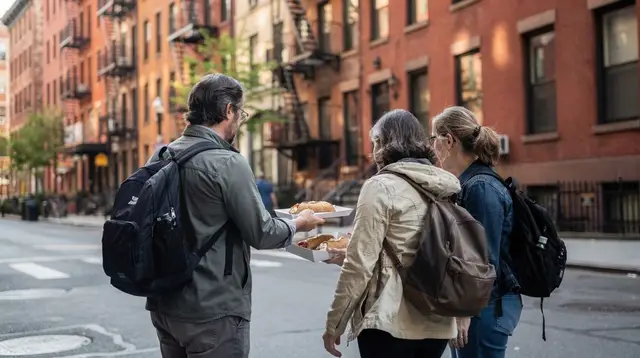
Independent exploration of Jackson Heights is entirely possible with a little research, but the neighborhood’s sheer density of similar-looking storefronts — dozens of small restaurants along a few blocks, many without English signage or online reviews — makes a guided tasting walk genuinely useful here in a way it might not be in a more tourist-oriented part of the city. A guide who knows the neighborhood can route a two-to-three-hour walk through South Asian, Latin American and, in some itineraries, Tibetan stops, with small tastings at each rather than one full meal, so a single outing covers far more ground than eating alone would allow.
For a route built specifically around this neighborhood, an off-the-beaten-path food tour through Jackson Heights works through several of the strip’s best-known stalls and restaurants in one guided walk.
A broader option covering Jackson Heights alongside other Queens pockets is an around-the-world food tour of Queens, which reflects just how many distinct culinary communities sit within a few subway stops of each other in this borough. Travelers who want a slower-paced, narrated walk can look at a Queens culinary walking tour on foot that pairs food stops with neighborhood history.
Anyone extending their Queens food trip to neighboring Astoria, another famously diverse and food-rich neighborhood a short ride away, might also consider an Astoria small-group walking and food tasting tour as a complementary outing on a different day, since trying to fold both neighborhoods into a single visit tends to rush both.
Prices, tax and tipping: what to actually expect
Menu prices in Jackson Heights, like everywhere in New York City, do not include sales tax. New York State and City sales tax comes to 8.875% and is added at the register or on the bill, exactly as it would be at a restaurant in Manhattan. Where Jackson Heights genuinely differs is in the sticker price itself: a filling meal at a family-run restaurant here commonly runs less than a comparable dish would cost closer to Midtown or Downtown Manhattan, reflecting lower rents and a customer base of local residents rather than visitors paying premium prices.
Tipping etiquette is worth a specific note. At Manhattan’s more formal restaurants, 18-20% of the pre-tax bill has become the standard expectation. At Jackson Heights’ smaller, family-run restaurants and counters, many regulars and locals tip closer to 15-18%, reflecting both the more casual service style and lower overall bill totals — though this varies restaurant by restaurant, and some already build a service charge into the check, so it is worth checking each bill rather than assuming one fixed rule applies everywhere.
| Item | Typical Jackson Heights price | Typical Manhattan price |
|---|---|---|
| Chaat plate or momos (tasting portion) | $5-9 | $10-16 |
| Biryani or full entree | $12-18 | $20-30 |
| Sweets by weight (small box) | $6-10 | $10-15 |
| Street taco or empanada | $2-4 each | $4-7 each |
Timing: mind the mid-afternoon lull
One practical detail that trips up first-time visitors: a number of Jackson Heights’ smaller, family-run restaurants close for a stretch in the mid-afternoon between lunch and dinner service, reopening in the early evening. This is common practice at many of the smaller South Asian and Latin American kitchens along 74th Street and Roosevelt Avenue, though larger or more tourist-facing restaurants may stay open continuously.
The safest windows are a lunch service, roughly from noon to 2:30pm, or a dinner service starting from around 6pm. Arriving at 3:30 or 4pm hoping to walk into any restaurant that catches your eye is the most common way to be disappointed by shuttered gates, so checking current hours in advance for any specific restaurant on a must-visit list is worth the extra minute.
Pairing Jackson Heights with the rest of your Queens visit
Jackson Heights sits within easy subway reach of two of the region’s three major airports, JFK and LaGuardia, both in Queens, which makes the borough a natural stop for travelers arriving or departing with time to spare, rather than only a destination reached from Manhattan. It also sits close, by subway standards, to Flushing and Long Island City, though each of those neighborhoods rewards its own dedicated visit rather than being rushed into the same afternoon as Jackson Heights.
For visitors building a broader itinerary that spans multiple boroughs, Jackson Heights fits naturally into a day that also touches Astoria for an evening meal, or can stand entirely on its own as a half-day food-focused outing from a Manhattan base. Either way, budget the subway ride honestly: 20-25 minutes each direction from central Manhattan, more from the edges, which makes Jackson Heights a real excursion rather than a five-minute detour.
Jackson Heights food tour: frequently asked questions
How do I get to Jackson Heights from Manhattan?
Take the E, F, M or R train, or the 7 train, to the Jackson Heights-Roosevelt Av station, which all five lines share. From Midtown Manhattan the ride typically runs 20-25 minutes, and from Lower Manhattan or the Upper West Side it can take longer. This is not a five-minute hop — plan it as a half-day or evening trip.
Is Jackson Heights safe and easy to visit for first-time visitors?
Jackson Heights is a residential, working neighborhood that welcomes visitors, with busy commercial strips along Roosevelt Avenue, 37th Avenue and 74th Street. Standard city precautions apply, as anywhere in New York. It is far less geared toward tourism than Manhattan, which is exactly its appeal for food.
What kind of food is Jackson Heights known for?
The neighborhood is best known for South Asian food (Indian, Bangladeshi, Nepali and Pakistani kitchens concentrated along 74th Street and Roosevelt Avenue), Latin American food (Colombian, Mexican, Ecuadorian and other kitchens along Roosevelt Avenue and side streets), and a small but well-regarded cluster of Tibetan restaurants nearby in Woodside and Elmhurst that many food tours also fold in.
Are prices really lower than Manhattan?
Generally yes. A filling meal at a Jackson Heights family-run restaurant commonly costs noticeably less than a comparable sit-down meal in Manhattan, since rents and overhead are lower and the food scene serves local residents first, tourists second.
Do I need to tip, and how much sales tax will I pay?
New York State and City sales tax of 8.875% applies to restaurant bills in Jackson Heights exactly as it does in Manhattan, and it is never included in a menu price. Tipping is still expected at small, family-run restaurants, though locals and regulars often tip closer to 15-18% rather than the 20% that has become standard at more formal Manhattan restaurants — check the bill, since some places already add a service charge.
What time of day should I go?
Aim for a lunch service (roughly noon to 2:30pm) or a dinner service (from around 6pm), since a number of smaller family-run kitchens close for a few hours in the mid-afternoon between the lunch and dinner rushes. Calling ahead or checking current hours before making a special trip for one specific restaurant is worth the extra step.
Can I combine Jackson Heights with other Queens neighborhoods in one day?
Yes. Jackson Heights sits close to Astoria, Flushing and Long Island City on the subway map, though each deserves its own dedicated visit rather than being rushed. A single well-planned day could pair a Jackson Heights lunch with an Astoria evening, but treat Flushing as a separate trip given the further distance.
Is a guided food tour worth it over exploring on my own?
A guided tour removes the guesswork of which of dozens of similar-looking storefronts are worth eating at, and typically includes tastings across several kitchens in one outing rather than one full meal at one restaurant. Independent exploration works too, especially with some research beforehand, but a guide adds context on the neighborhood’s immigrant history that is easy to miss walking past storefronts alone.
Food Tours & Tastings
Verified deep-linked GetYourGuide tours. Book through these links and we earn a small commission at no cost to you.
GetYourGuide does not provide a product photo for this activity — the image shows the meeting point, photographed by us.