Getting to Williamsburg and Bushwick from Manhattan
Williamsburg sits directly across the East River from Manhattan, and the fastest way in is the L train: board at Union Square-14th St and step off around 15 minutes later at Bedford Ave, right in the middle of the neighborhood’s main commercial strip. From there it’s a flat, walkable few blocks to the waterfront and to Smorgasburg’s seasonal site. Bushwick, the neighborhood just east of Williamsburg with the denser concentration of bars and galleries, sits two more L stops out — get off at Morgan Ave or Jefferson St depending on which end you’re heading for.
One thing worth building into any plan: the L train is not immune to weekend maintenance. The MTA periodically schedules work on this line that suspends subway service between stations and substitutes shuttle buses for part or all of a weekend. It doesn’t happen every week, but it happens often enough that assuming uninterrupted L service on a Saturday or Sunday is a mistake. Check the MTA’s service-status page or app the night before or morning of your trip — see our subway fare and planning guide for how OMNY and MetroCard work if you end up switching lines. If the L is out, the G train plus a transfer, or a ferry from Manhattan’s East Side, are the usual workarounds locals reach for.
A separate way in that many visitors overlook entirely is the East River Ferry, which docks at North Williamsburg and gives a genuinely scenic approach to the neighborhood, with the Manhattan skyline receding behind you as you cross. It costs the same as a subway fare with an OMNY tap and runs on its own schedule, so it’s worth checking timing rather than assuming a boat is always about to leave.
Smorgasburg: the open-air food market
Smorgasburg is the reason a lot of first-time visitors add Williamsburg to their list. It’s an outdoor food market, not a single restaurant or building, made up of dozens of independent vendors selling everything from lobster rolls and ramen burgers to vegan barbecue and elaborate desserts, most of it designed to be eaten standing up or perched on a nearby ledge. Entry is free — you only pay for what you order, and a satisfying lunch built from two or three small plates typically runs somewhere in the range of $20-35 per person depending on how much you sample.
The market is seasonal, running roughly from April through October, with the exact schedule and site shifting slightly year to year, so it’s worth confirming current dates and location before you plan a special trip around it — a market that isn’t open on a given weekend is a common and avoidable disappointment. When it is running, it’s typically a Saturday event, and it draws real crowds by early afternoon; arriving close to opening gets you shorter lines at the most popular stalls and a much easier time finding a place to sit.
Smorgasburg isn’t the only outdoor food draw in the area — the broader Williamsburg food scene, including sit-down restaurants and specialty shops well beyond the market itself, is worth a slower exploration if you have the time. A guided walk through the neighborhood’s food spots can be a useful shortcut if you’d rather eat well than research restaurants yourself.
Domino Park: the free waterfront green space
Domino Park runs along the East River on the site of the old Domino Sugar Refinery, and it’s one of the better free things to do in the borough. The park keeps some of the refinery’s industrial machinery on display as sculpture, has a long elevated walkway right along the water, a small beach-like sand area, sports courts, and a set of lawns that fill up on warm afternoons. The park costs nothing to enter and is open during standard daylight park hours.
The real draw for most visitors is the view: Domino Park looks almost directly across the East River at the Manhattan skyline, and it’s a genuinely good spot for photographs, especially as the sun sets behind the towers to the west. It gets busy at golden hour for exactly that reason, so if you want a clear shot, either arrive with time to find your spot or accept that you’ll be sharing the railing with plenty of other people doing the same thing.
Domino Park connects reasonably easily on foot to the Williamsburg Bridge and, further south, to the Brooklyn waterfront path that eventually reaches DUMBO — an ambitious but doable walk for visitors who enjoy waterfront routes and want to link two Brooklyn neighborhoods without going back underground. For a more structured version of that kind of route, the DUMBO and Brooklyn Heights promenade guide covers the DUMBO end of things.
Bushwick: bars, galleries, and street art
Where Williamsburg has smoothed out into a mix of chain stores and long-established boutiques over the past decade, Bushwick — the neighborhood immediately to its east — still carries more of the raw, industrial-turned-creative feel that Williamsburg itself was known for a generation ago. Its bar and gallery scene is concentrated mainly around the Morgan Ave and Jefferson St L train stops, in a stretch of converted warehouses and former factory buildings.
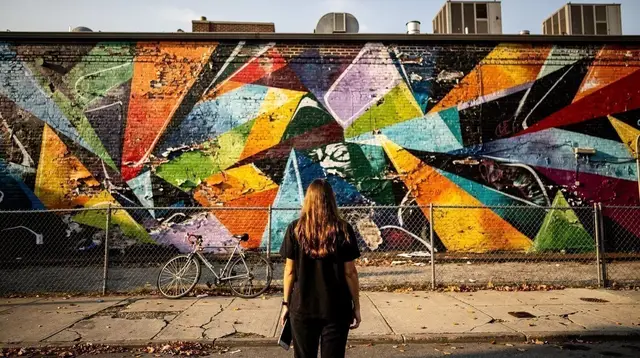
The area is particularly known for its street art and murals, much of it large-scale and changing over time as buildings get repainted and new artists move through; walking a few blocks off the main avenues around these stations turns up mural after mural without needing a formal tour, though a guided walk can add context on individual artists and the neighborhood’s transformation that’s easy to miss on your own. Galleries are scattered through the same blocks, many of them small, artist-run spaces with irregular hours, so an evening visit works better for bars and murals than for gallery-hopping, which tends to reward a weekend afternoon instead.
Bushwick’s nightlife runs from dive bars to more polished cocktail spots, and it’s generally where visitors go once Williamsburg’s earlier-closing restaurants and cafés wind down for the night. As with any nightlife-heavy stretch of any city, ordinary urban precautions apply after dark: stick to streets with active foot traffic, know your route back to a subway station before you set out, and treat the area the way you would any unfamiliar nightlife district rather than assuming it’s uniformly safe simply because it’s popular with visitors. It’s a genuinely fun part of the city to explore at night, not a place that needs to be avoided — just not one to wander through half-lost at 3am without a plan.
Rooftop bars and skyline views
Both Williamsburg and Bushwick have a decent cluster of rooftop bars, and the appeal is straightforward: elevated views back toward the Manhattan skyline, often paired with a more relaxed, less tourist-heavy crowd than rooftop bars closer to Midtown. Cocktails at these spots typically run $15-18, in line with much of the rest of Brooklyn’s bar scene, though some rooftops add a modest cover charge on weekend nights or reserve tables for parties buying bottle service.
Sunset is the busiest window at any rooftop with a river-facing view, for the obvious reason that it’s when the skyline looks best; arriving an hour or so before sunset on a weeknight is a reasonable way to get a table without a wait. Several rooftops don’t take reservations at all and operate strictly first-come, so checking a venue’s specific policy before you go saves a wasted trip.
What to actually plan for a Williamsburg and Bushwick day
A realistic day here starts with the L train from Union Square (checked in advance for weekend service changes), a late-morning arrival at Bedford Ave, a couple of hours at Smorgasburg if it’s in season, a walk down to Domino Park for skyline photos, and then either a return to Manhattan in the late afternoon or a push further east into Bushwick for murals, galleries and dinner before the bar scene picks up.
| Stop | Time needed | Cost |
|---|---|---|
| L train from Union Square to Bedford Ave | ~15 min | Standard subway fare |
| Smorgasburg (seasonal, April-October) | 1.5-2.5 hours | Free entry, $20-35 food |
| Domino Park | 45-90 min | Free |
| Bushwick murals and galleries | 1.5-3 hours | Free |
| Rooftop bar at sunset | 1-2 hours | $15-18 per cocktail |
For visitors who’d rather have someone else handle the route and the commentary, a guided walking tour through Brooklyn’s neighborhoods is a straightforward way to see Williamsburg’s highlights alongside other parts of the borough without piecing together the subway connections yourself.
a guided two-hour walk through the best of Brooklyn is a practical option if you want a structured introduction to the borough before exploring Williamsburg and Bushwick on your own afterward. For a broader taste of the city beyond Brooklyn on the same trip, a wider Big Apple sightseeing experience pairs well with a Williamsburg afternoon if you’re building a multi-neighborhood itinerary. And for travelers curious about the city’s legal cannabis dispensaries and culture, which have a visible presence in parts of Brooklyn including this area, a guided cannabis-focused tour of the city is a niche but genuine option worth knowing about.
How Williamsburg and Bushwick fit into a wider Brooklyn trip
Williamsburg and Bushwick are only one slice of Brooklyn, and pairing them with other parts of the borough makes for a fuller day or weekend. DUMBO, with its cobblestone streets and postcard view of the Brooklyn Bridge and Manhattan Bridge, sits south along the waterfront and is a natural add-on for anyone who enjoyed Domino Park’s river views.
Coney Island, further out at Brooklyn’s southern edge, offers the boardwalk-and-amusement-park experience that Williamsburg doesn’t attempt to replicate, and is best treated as its own separate trip given the distance. Closer to the winter holidays, the Dyker Heights light displays are a completely different — and completely free — reason to head into Brooklyn, best visited from late November through December.
If you’re building a longer stay, a two-day Manhattan and Brooklyn itinerary is a reasonable framework for slotting Williamsburg in alongside the borough’s other highlights, and our broader Brooklyn destination guide lays out how the neighborhood fits into the rest of the borough. For a more candid look at how much of Brooklyn is realistically doable in a single day, see Brooklyn in one day: a realistic itinerary — trying to cram Williamsburg, DUMBO and Coney Island into the same afternoon is a common overreach.
Things to do more broadly across the borough, sorted by category, are listed on the Brooklyn things-to-do hub, and Williamsburg-specific listings sit on the Williamsburg things-to-do page. For food specifically, the Williamsburg food tour guide goes deeper than this page can on restaurants and specialty shops beyond Smorgasburg, while the Williamsburg street art and nightlife tour guide and the Williamsburg bar crawl guide cover the evening side of the neighborhood in more detail.
Anyone drawn to Brooklyn’s waterfront in general should also look at the Brooklyn Bridge and DUMBO walking tour guide, the Coney Island boardwalk history guide, the Brooklyn bike tour guide, and, seasonally, the Dyker Heights Christmas lights guide.
Williamsburg and Bushwick: frequently asked questions
Does the L train always run on weekends?
No. The MTA periodically schedules maintenance work on the L line that suspends service between certain stations, replacing the subway with shuttle buses for part or all of a weekend. This doesn’t happen constantly, but it’s common enough that you should check the MTA’s service status the day before or morning of your trip rather than assuming normal service.
Is Smorgasburg open year-round?
No. Smorgasburg is seasonal, typically running from around April through October, with the schedule and exact site subject to change each year. Confirm current dates before planning a trip specifically around it, since the market being closed on a given weekend is a common surprise for visitors who assumed it ran continuously.
Is Domino Park free?
Yes. Domino Park has no entry fee and is open during standard park hours. It’s one of the better free waterfront views of the Manhattan skyline anywhere in Brooklyn.
Where exactly is Bushwick’s bar and gallery scene?
It’s concentrated mainly around the Morgan Ave and Jefferson St stops on the L train, a few stops past Bedford Ave in Williamsburg. The area is known for converted warehouse bars, artist-run galleries, and large-scale street murals scattered through the surrounding blocks.
How much do rooftop bar cocktails cost in Williamsburg and Bushwick?
Typically $15-18 per cocktail, broadly in line with the rest of Brooklyn’s bar scene. Some rooftops add a cover charge on busy weekend nights, and many don’t take reservations, so it’s worth checking a specific venue’s policy before heading over.
Is Williamsburg or Bushwick safe to walk around at night?
Both neighborhoods are heavily visited and generally busy well into the evening, but neither should be treated as risk-free simply because they’re popular. The usual precautions for any city’s nightlife district apply: stick to well-trafficked streets, know your route back to a subway station in advance, and stay aware of your surroundings, particularly in Bushwick’s quieter side streets away from the main bar strips.
Can I walk from Williamsburg to DUMBO?
Yes, along the Brooklyn waterfront, though it’s a genuinely long walk best suited to visitors who enjoy an extended waterside route rather than a quick connection. Most visitors instead treat Williamsburg and DUMBO as separate stops on the same day, connecting by subway.
What’s the best time of year to visit Williamsburg?
Late spring through early fall is best, both because it aligns with Smorgasburg’s season and because the waterfront parks and rooftop bars are at their most enjoyable in warm weather. A weekday visit spreads the crowds out more evenly than a Saturday, when the market and the waterfront are both at their busiest.