Greenwich Village Food Tour Guide
What does a Greenwich Village food tour actually include?
A guided walking tour typically runs about 3 hours and includes tastings at 4-6 stops along streets like Bleecker and MacDougal, plus historical commentary. The guide fee covers logistics and storytelling, not a discount on the food itself, and NYC's 8.875% sales tax still applies to anything bought separately.
Why Greenwich Village works so well for a walking food tour
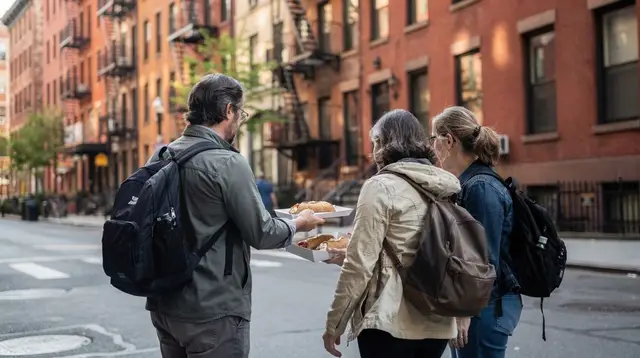
Greenwich Village is one of the few Manhattan neighborhoods where a genuinely old, tangled street pattern survives largely intact, and that geography is exactly what makes a food-focused walk here rewarding. Streets like Bleecker Street and MacDougal Street were never squeezed onto the numbered grid that governs most of Manhattan north of Houston Street; they curve, cross at odd angles, and pack decades — in some cases over a century — of pizzerias, cafes, bakeries and wine bars into a compact, walkable footprint. You can cover a satisfying loop of tastings without ever needing a taxi, a subway transfer, or more than about a mile and a half on foot.
The neighborhood’s food identity runs in layers: red-sauce Italian institutions that predate the area’s bohemian reputation, coffeehouses tied to the folk and jazz scenes of the mid-20th century, and a newer wave of small-batch bakeries and natural wine bars that arrived as rents shifted. A well-built walking route threads through several of these layers rather than sticking to one era or one cuisine, which is part of why both guided tours and independent self-guided walks tend to favor the same handful of blocks.
That layering is also why a Greenwich Village food walk tends to hold up on a repeat visit in a way that a single-cuisine tour elsewhere might not. A visitor who did the classic pizza-and-cannoli loop on a previous trip can come back and follow a route weighted toward the wine bars and specialty grocers instead, without retracing the same stops. Because the neighborhood is compact, it’s also easy to treat a food walk as a spine for the afternoon rather than the entire plan — arriving early to linger in Washington Square Park, or extending west into the quieter residential blocks once the tastings wrap up.
Getting there: the two stations that matter
Greenwich Village sits conveniently between two subway stations, and knowing which one suits your starting point saves backtracking.
West 4th St-Washington Square is served by the A, B, C, D, E, F and M lines, making it one of the best-connected stations in lower Manhattan. It drops you within a couple of minutes’ walk of Washington Square Park, the natural anchor point for a walk that then fans out toward Bleecker Street and MacDougal Street.
Christopher St-Sheridan Square, served by the 1 train, sits a few blocks west and south, closer to the quieter, more residential stretch of the West Village. It’s a useful starting or ending point if your route swings toward Bedford Street, Grove Street or the West Village’s more tucked-away corners.
Either station puts you within about a 10-minute walk of the neighborhood’s main tasting corridor, so the choice mostly comes down to which subway line already serves your hotel or the rest of your day’s plans. For a full walking route through the wider neighborhood beyond food stops, the Greenwich Village walking tour guide covers the area’s landmarks and literary history in more depth.
What a typical route covers
Most walking food tours in Greenwich Village — guided or self-planned — follow a similar shape: start near Washington Square Park, work along or near Bleecker Street, cut through MacDougal Street, and finish somewhere in the West Village’s quieter blocks. Along the way, a route commonly touches on:
- Historic pizzerias, some dating to the early-to-mid 20th century, known for coal- or gas-oven slices and whole pies rather than the folded street-corner slice found elsewhere in the city.
- Italian bakeries and pastry shops along and near Bleecker Street, known for cannoli, sfogliatelle and espresso rather than full meals.
- Cafes with musical or literary history, tied to the neighborhood’s folk-revival and Beat-era past, still serving coffee and light bites today.
- Wine bars, often small and specializing in natural or lesser-known regional wines, typically visited later in a route as a seated, slower stop.
- A cheese, charcuterie or specialty grocery stop, where tours often include a small tasting plate rather than a full course.
A tour doesn’t need to hit every category above to feel complete — most guided itineraries pick four to six stops total, balancing walking time against how long each tasting takes.
Group size and how it shapes the experience
Group size varies by operator and affects how the walk actually feels on the ground. A smaller group moves faster between stops, gets more direct time with the guide at each tasting, and has an easier time fitting around a counter or a small wine bar table. A larger group tends to take longer at each stop simply because of logistics — settling everyone in, distributing tastings, waiting for the group to reassemble before moving on. Neither format is wrong, but it’s worth checking the group size on a specific listing if a quieter, more conversational pace matters to you, versus a livelier, more social one.
Operators also differ in how they frame the walk itself. A tour built around a specific angle, such as the Greenwich Village food and culture tour, tends to spend more time on the stories behind each stop, while a more straightforward Greenwich Village food tour keeps the emphasis on moving efficiently between tastings. Reading the listed stops and format ahead of time will tell you more about the pace to expect than the tour’s title alone.
How long it actually takes and how much food to expect
A guided walking food tour through Greenwich Village generally runs about 3 hours, covering roughly 1 to 1.5 miles at a relaxed pace with stops built in. That timeframe usually includes 4 to 6 tastings — small plates, a slice, a pastry, a pour of wine — rather than full-sized meals at each stop, though the cumulative effect by the end is often equivalent to a substantial lunch or dinner.
This is worth planning around. If you’re booking a tour for early afternoon and it includes half a dozen tastings, a very large breakfast beforehand may leave you unable to enjoy the later stops. Conversely, arriving genuinely hungry — but not starving — tends to make the pacing work best, since the food is spread across three hours rather than served all at once.
What it costs, and what the fee actually buys
Per-person pricing for a guided Greenwich Village food tour varies by operator, group size, and how many tastings are included, so it’s worth checking the specific listing before booking rather than assuming a flat citywide rate. What’s consistent across operators is what the fee is actually paying for: a guide’s time, a planned route, reservations or standing arrangements at popular counters that might otherwise mean a wait, and historical or cultural narration tied to each stop.
It’s worth being direct about one thing: a guided tour is not a way to get the same food more cheaply than buying it yourself. The tour price is a service fee layered on top of the food’s own cost — in some cases the operator has negotiated a modest per-person food allotment with the venues, in others tastings are priced into the ticket separately from a venue’s normal menu. Either way, walking the same four or five addresses independently and paying each shop’s own posted prices will typically cost about the same in food, or less, since you’re not also paying for the guiding and storytelling. The value of a guided tour is the curation, the logistics, and the context — not a discount.
For travelers who’d rather book a specific, well-reviewed operator directly, options include a straightforward Greenwich Village food tour covering the neighborhood’s classic stops, a broader street food walking tour of the Village for those who want a wider mix of casual bites, and a themed food and music tour tracing the neighborhood’s folk history for visitors interested in the area’s cultural past alongside the eating.
Guided tour vs. independent walk
| Guided food tour | Self-guided walk | |
|---|---|---|
| Typical duration | About 3 hours, fixed pace | However long you choose |
| Tastings included | 4-6, pre-arranged | However many you order |
| Cost structure | Per-person ticket price + separate food-purchase policy varies by operator | Pay each venue’s menu price directly |
| What you’re paying for | Guiding, route planning, reservations, historical narration | Nothing beyond the food itself |
| Best for | First-time visitors, limited time, wanting context | Repeat visitors, flexible schedules, budget-conscious eaters |
| Sales tax | 8.875%, applies to any separate purchases | 8.875%, applies at every till |
Sales tax and tipping: two separate additions to expect
New York City sales tax is 8.875%, and it applies to prepared food and drink purchases whether you’re buying a slice at a counter, a pastry at a bakery, or a glass of wine at a seated wine bar. This tax is never folded into the price shown on a menu or a chalkboard — it’s added at the register or when the check arrives, so a $5 slice becomes a little over $5.44 once tax is applied.
Tipping works differently depending on the type of stop. At sit-down restaurants, wine bars and anywhere with table service, an 18-20% tip on the pre-tax subtotal is the standard expectation, and it’s genuinely expected rather than optional — service staff in New York rely on tips as a substantial part of their income. At walk-up counters, pizza-by-the-slice windows, and bakery stands — the kind of quick, order-at-the-register stops that make up much of a Village food walk — tipping is not expected in the same way, though many counters keep a tip jar for spare change, which is appreciated but discretionary.
On a guided tour, ask in advance whether any seated wine bar or restaurant stop involves table service, since that’s the point where the 18-20% guideline applies and where the group’s tab is sometimes handled differently than at the walk-up stops.
Dietary restrictions and what to flag in advance
Greenwich Village’s food stops lean heavily on wheat-based staples — pizza dough, pastry, bread — along with dairy in the cheese and gelato stations, so a guided tour built around a fixed set of tastings isn’t automatically flexible for gluten-free, dairy-free or vegan travelers. Most operators can accommodate dietary restrictions with advance notice, since it may mean swapping a stop or arranging an alternative tasting at the same venue, but this is worth flagging when booking rather than mentioning on the day. A self-guided walk sidesteps this issue entirely, since you can simply choose which counters to stop at and skip the ones that don’t fit, but you lose the pre-arranged access and narration that make the guided version worth its fee for many first-time visitors.
A Sunday note worth planning around
Greenwich Village’s food scene leans heavily on small, independently owned businesses, and a number of them close early or entirely on Sundays — a contrast to the extended, often 24-hour rhythm found in some other parts of Manhattan. Family-run bakeries in particular are prone to Sunday closures or shortened hours, and a handful of the neighborhood’s older, more traditional Italian shops keep to schedules set decades ago that don’t always match modern tourist expectations.
If you’re planning a Sunday visit, whether joining a guided tour or building your own route, it’s worth checking each specific stop’s current hours a day or two ahead rather than assuming every address on a list will be open. Operators running scheduled tours generally build their Sunday routes around businesses that stay open, but an independent walk on a Sunday afternoon benefits from a quick hours check first.
Choosing between operators
Several tours cover overlapping ground in Greenwich Village, and the differences tend to come down to group size, tasting count, and thematic framing rather than the underlying streets walked. A tour billed as covering “6 tastings,” for instance — such as the trendy Greenwich Village tour with six tastings — signals a heavier eating pace than a tour that lists three or four stops, which matters for how you plan meals around it that day.
Others frame the walk around a specific narrative, like the Greenwich Village food and history tour, pairing tastings with deeper background on the neighborhood’s bohemian and immigrant past.
Whichever operator you choose, checking the listed duration, number of tastings, and whether any seated wine or restaurant stop is included will tell you more about what to expect than the tour’s name alone.
Pairing a food walk with the rest of the neighborhood
A three-hour food tour leaves time before or after to see more of the Village on foot. Washington Square Park anchors the north end of most routes and is worth a slow pass regardless of your food plans. For a fuller sense of the neighborhood’s literary and architectural history beyond its kitchens, the Greenwich Village walking tour covers that ground directly. Visitors curious about the area’s screen history might also enjoy the Friends TV show Greenwich Village tour, which passes some of the same streets from a different angle.
Those extending their food exploration beyond the Village have nearby options too: the Chinatown and Little Italy food walk sits a short subway ride south, while Harlem’s soul food tour and Williamsburg’s food tour in Brooklyn offer very different neighborhood food cultures if your trip has time for more than one borough’s worth of eating.
For a broader sense of how a food-focused afternoon fits into a longer New York itinerary, the three days classic New York plan and the five days food neighborhoods itinerary both build around similar walking-and-eating days.
If you’re weighing this stop against other food-forward options across the wider region, the Long Island wine tour from NYC transport guide covers a very different, day-trip version of the same idea.
And if budgeting for a food-heavy day is part of your planning, the New York City budget planning guide and the things to do in Greenwich Village category page round out how this stop fits into a wider Manhattan visit — alongside the SoHo and Chinatown and Chelsea and the High Line areas nearby for those extending the walk further across downtown Manhattan.
Food Tours & Tastings
Verified deep-linked GetYourGuide tours. Book through these links and we earn a small commission at no cost to you.
GetYourGuide does not provide a product photo for this activity — the image shows the meeting point, photographed by us.