An elevated park built on a working freight line
The High Line is one of Manhattan’s more unusual public spaces: a mile and a half of elevated park built directly on top of a disused freight railway that once carried trains through the meatpacking district and Chelsea’s warehouses. Rather than tearing the structure down, the city and a community group turned it into a planted, pedestrian-only promenade raised roughly 30 feet above the street grid, running north from around Gansevoort Street up through Chelsea to the low 30s near Hudson Yards.
It is free to enter, open every day within its posted hours, and requires no ticket, no reservation, and no line — a rarity for a New York attraction of its profile. That openness is also exactly why it gets crowded: there is no capacity cap on how many people can be on the walkway at once.
Below the park, at street level, Chelsea itself is one of Manhattan’s densest concentrations of contemporary art galleries, dozens of them clustered in former warehouse blocks roughly between the High Line and the Hudson River, most free to walk into. A few blocks south, Chelsea Market occupies a converted Nabisco factory and functions as both a food hall and a small shopping arcade — also free to wander, though the vendors inside charge tourist-district prices. Together, the three pieces make a natural half-day loop: gallery browsing, an elevated walk, and a market stop, all within easy walking distance of one another.
Getting there and finding an entrance
The High Line does not have a single main entrance the way a park with gates does — it has a series of stairway and elevator access points spaced along its length, and most visitors simply join at whichever one is closest to where they already are rather than walking to a designated start. The southern end sits near Gansevoort Street in the meatpacking district; the northern end lets out near the 30th Street corridor by Hudson Yards and the Edge observation deck. Access points in between serve 14th Street, 16th Street, 18th Street, 20th Street, 23rd Street, 26th Street, and 30th Street, several with elevators for step-free access, others stairs only.
By subway, the closest lines are the A/C/E at 14th Street or 23rd Street (Eighth Avenue) and the L train at Eighth Avenue, both a short walk from the southern and mid-park entrances; the 7 train to 34th Street-Hudson Yards serves the northern end. From Midtown, the ride is typically 10 to 15 minutes plus a short walk. There is no dedicated parking for the High Line, and Chelsea’s street parking is scarce and metered, so arriving by subway or on foot from a nearby neighborhood such as the Village or SoHo is the practical option.
Walking the High Line: what to actually expect
The walkway itself is narrow — generally wide enough for a comfortable two-way flow of foot traffic, not much more — and it runs at a fixed, unhurried pace because there is nowhere to overtake easily when it’s busy. On a quiet weekday morning that narrowness is part of the charm: a raised, planted path with sightlines down side streets and glimpses of the Hudson, moving at walking speed above the traffic.
On a Saturday afternoon, a summer evening, or basically any weekend from late spring through early fall, the same narrow path fills with a slow-moving crowd, and “leisurely stroll” gives way to shuffling in a queue-like line at the busiest pinch points, stairways, and viewing platforms. It is worth being honest about this rather than promising a quiet walk at any hour: the High Line is one of the most visited outdoor spaces in the city, and its layout means crowding is felt more acutely than it would be in a wide-open park like Central Park.
The practical response is timing rather than avoidance. Weekday mornings, right after opening, are consistently the calmest window, followed by early weekday afternoons outside lunch rush. Weekend mornings before roughly 10am are workable; anything from midday Saturday through Sunday evening, and any evening in June through August, should be expected to be busy, sometimes very busy near the Chelsea Market and 14th Street access points where foot traffic from the market and the meatpacking district funnels onto the park. Photographers chasing an empty-feeling shot should plan for opening time on a weekday, not assume any random hour will do.
Along the route, look for the self-seeded-style plantings that reference the wild growth that colonized the abandoned tracks before the park was built, several sculpture and rotating art installations, benches built into the old rail bed, and a handful of spots with river views toward New Jersey. There is no food for sale directly on the walkway itself in most stretches, which is one more reason Chelsea Market functions as the natural break point on a walk that runs the park’s length.
Chelsea’s gallery district
West of the High Line, roughly between Tenth and Eleventh Avenues from the high teens through the high 20s in cross streets, sits one of the largest concentrations of contemporary art galleries in the city — a legacy of the neighborhood’s cheap warehouse space decades before the High Line existed, which drew galleries first and the elevated park later.
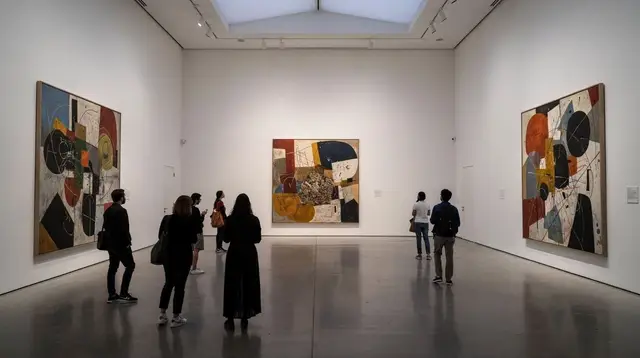
Admission to walk into these galleries is free, they are commercial spaces rather than museums, and most keep Tuesday-through-Saturday hours with many closed on Sundays and Mondays, so a weekday visit lines up well with both quieter High Line hours and open gallery doors. The district rewards browsing rather than a fixed checklist: gallery programs rotate every few weeks, and dropping into a run of them along a single block is the normal way to see it.
For visitors who would rather have context than wander cold, a guided option covers the area’s shift from rail yards and warehouses to gallery district in one route:
a guided walk through Chelsea’s transformation from industrial waterfront to arts neighborhood, or, for a more gallery-focused version, a guided visit built specifically around the current gallery scene, useful for anyone who wants a curated introduction rather than picking doors at random.
Chelsea Market: free to enter, not cheap to eat in
Chelsea Market sits inside a converted early-20th-century Nabisco factory building on Ninth Avenue, and functions as an indoor food hall lined with dozens of individual vendors plus a scattering of small shops. Walking through the building costs nothing — there is no entry fee or ticket of any kind — but the food and goods sold inside run at New York tourist-district prices, not neighborhood-deli prices: expect a sit-down-equivalent lunch from a market vendor to land in the same $12-20 range as a fast-casual meal elsewhere in Manhattan, and specialty items, baked goods, and sit-down counters inside the market can run higher.
As everywhere in the city, the 8.875% sales tax is added at the register on top of the posted price, and it is not unusual for a market lunch for one to clear $20-25 once tax and a drink are factored in. Treat the market as a place to graze from a few vendors rather than expecting bargain prices simply because entry itself is free.
The market also gets busy, particularly around lunch hours and on weekends when it doubles as both a High Line rest stop and a destination in its own right; arriving before noon on a weekday gives the most breathing room at the food counters.
A practical half-day route
A workable order for a first visit: start at the southern High Line entrance near Gansevoort Street in the morning, walk north at an easy pace, and exit around 16th or 18th Street to detour into a run of Chelsea galleries for half an hour to an hour. Rejoin the High Line, continue north, and either exit near 14th-16th Street on the way to Chelsea Market for a late lunch, or push on to the 20s and 30s for the quieter northern stretch before doubling back.
Visitors combining this with the wider West Side can continue north toward Midtown and Times Square or connect toward Lower Manhattan to the south on the same day, though trying to do the full High Line, all of Chelsea’s galleries, and Chelsea Market properly in one outing is ambitious — a half day covers the highlights, closer to a full day if gallery-hopping is the priority.
Those staying centrally and traveling light for the day might want the baggage handled separately: a short-term luggage storage service near Central Park is a practical option for visitors combining a Chelsea half-day with sightseeing elsewhere before checking into a hotel.
| Element | Cost | Notes |
|---|---|---|
| High Line entry | Free | No ticket, multiple entrances, no reservation |
| Chelsea gallery visits | Free | Commercial galleries, Tue-Sat typical hours |
| Chelsea Market entry | Free | Individual vendor prices apply inside |
| Chelsea Market lunch | ~$15-25 with tax | 8.875% sales tax added at register |
| Guided Chelsea/gallery tour | Paid, price varies | Covers context a self-guided walk skips |
Where this fits with the rest of Manhattan
Chelsea and the High Line sit between two very different Manhattan experiences: the dense, historic streets of SoHo and the Village to the south, and the vertical, commercial energy of Midtown to the north, with the newer Hudson Yards development and its Edge observation deck at the High Line’s northern tip.
For visitors weighing where an observation deck fits into a High Line day, the Edge at Hudson Yards guide and the Summit One Vanderbilt guide compare options elsewhere in Manhattan. Gallery-focused travelers who enjoy Chelsea’s scene may also want the SoHo independent galleries guide for a second, denser gallery crawl on another day.
For a first visit to New York overall, a Chelsea and High Line half-day slots naturally into broader plans such as the one-day Manhattan essentials itinerary or, for a longer stay, the two-day Manhattan and Brooklyn itinerary, either of which can absorb this neighborhood as one block of a fuller day. General things to do in Manhattan rounds out options beyond this specific pocket of the West Side, and the citywide subway fare guide covers OMNY and MetroCard basics for getting here and onward.
Two background facts worth knowing before the visit: the city’s 8.875% sales tax is never included in a posted price, which applies directly to anything bought inside Chelsea Market, and tipping 18-20% is standard at any sit-down counter or table service in the market, not just at full restaurants elsewhere in the city.
Chelsea and the High Line: frequently asked questions
Is the High Line free to visit?
Yes. The High Line has no entry fee, no ticket, and no reservation system. It is open to the public at any of its access points along the route during its posted daily hours, which vary seasonally.
How crowded does the High Line actually get?
Very crowded at peak times. The walkway is narrow, and weekend afternoons, summer evenings, and holidays regularly bring slow-moving, queue-like foot traffic at popular stretches and stairways. Weekday mornings are the reliably calmer option; there is no hour that guarantees an empty walk on a busy day of the week or season.
Where do I get on and off the High Line?
There is no single entrance. Stairway and elevator access points are spaced roughly every few blocks between Gansevoort Street at the southern end and the low 30s near Hudson Yards at the northern end, including stops near 14th, 16th, 18th, 20th, 23rd, 26th, and 30th Streets. Most visitors join at whichever entrance is closest to their location.
Is Chelsea Market free to enter, and is the food expensive?
Entry to the building is free with no ticket required. Food and goods sold by individual vendors inside run at typical New York tourist-district prices, and the city’s 8.875% sales tax is added at checkout on top of the posted price, so a market lunch commonly totals $15-25 once tax is included.
Are the Chelsea art galleries free to visit?
Yes, nearly all of Chelsea’s commercial galleries are free to walk into. Most keep Tuesday-through-Saturday hours and are closed Sunday and Monday, so a weekday visit works best for gallery-hopping.
How much time should I set aside for Chelsea and the High Line?
A half day, roughly three to four hours, covers a High Line walk, a stop at Chelsea Market, and a short run of galleries. Visitors who want to browse galleries in more depth or walk the full High Line length at an unhurried pace should plan closer to a full day.
Is the High Line wheelchair or stroller accessible?
Several access points along the route include elevators, though not every entrance does; stairs-only entrances are common at some cross streets. Checking which specific access point has an elevator before planning a route is worthwhile for anyone who needs step-free access.
When is the best time to visit to avoid crowds?
Weekday mornings shortly after opening are the most consistently quiet window, followed by early weekday afternoons outside lunch hours. Weekends, summer evenings, and holiday periods should be expected to be busy regardless of the hour chosen.