Chelsea Art Galleries and the High Line: A Free Gallery Walk
Are Chelsea's art galleries free to visit, and can they be combined with the High Line?
Yes. Nearly all Chelsea galleries, concentrated between 20th and 27th Streets west of Tenth Avenue, are free with no reservation needed. They sit a block or two from the High Line, whose Chelsea stretch is about 1.5 km, an easy 30-40 minute walk, making the two a natural pairing. Most galleries close Sunday and Monday, so plan the walk for Tuesday through Saturday.
A neighborhood built for wandering, not queuing
Chelsea’s art gallery district is one of the few genuinely free, unticketed things to do in Manhattan that also happens to be a serious cultural experience. Dozens of contemporary art galleries, ranging from blue-chip international names to small experimental spaces, cluster in the low-rise former warehouse blocks between 20th and 27th Streets, mostly west of Tenth Avenue. Unlike the Metropolitan Museum of Art or MoMA, there is no admission fee, no timed-entry ticket and no line at the door. You simply walk in, look around, and walk out — as many times as you like, at as many galleries as you like, in an afternoon.
This makes Chelsea a natural pairing with the High Line, the elevated park built on a disused freight rail line that runs right through the middle of the gallery district. The two sit close enough together that visitors regularly weave between them: duck into a gallery at street level, climb back up to the park, walk a few blocks, descend again for another gallery. Neither requires advance planning beyond knowing which days the galleries are open — and that single detail is where most visitors go wrong.
Where the galleries actually are
The heart of the district runs roughly from 20th Street up to 27th Street, concentrated west of Tenth Avenue and, in places, spilling toward Eleventh Avenue closer to the river. This is a compact footprint — about seven blocks north to south — but it packs in a genuinely large number of exhibition spaces. Many of the buildings here are former industrial warehouses and garages, several stories tall, with multiple galleries occupying different floors of the same address. It is not unusual to walk into a building expecting one gallery and find three or four, each running its own separate exhibition.
There is no single “main street” of galleries the way SoHo once had; the district is more of a grid of side streets, and part of the appeal is simply wandering block by block, checking storefronts and building directories as you go. A loose walking loop through the 20s, zigzagging between Tenth and Eleventh Avenues, covers a meaningful sample of the neighborhood in two to three hours at an unhurried pace.
Free admission, and why that matters
The single most important practical fact about Chelsea’s galleries is that admission is free, almost without exception. There is no ticket booth, no bag check fee, and typically no requirement to register in advance. Compare this to the paid, often timed-entry model of Manhattan’s major museums, and the difference in friction is dramatic: you can decide on a whim to step into a gallery, spend three minutes or thirty, and leave without any financial commitment.
This changes how the neighborhood is best experienced. Rather than picking two or three “must-see” galleries and researching them heavily in advance, most visitors do better simply walking the blocks and going wherever a window display or an open door catches their eye. Because there’s no cost to being wrong, there’s little downside to popping into a space that turns out not to interest you — you simply move to the next one. The trade-off is that gallery programming changes constantly, often every four to six weeks, so there’s no fixed list of “greatest hits” the way there is for a permanent museum collection; what’s on view is genuinely whatever happens to be up that month.
The days that trip visitors up
Here is the detail that catches out more visitors to Chelsea than any other: most galleries close on both Sunday and Monday. This is a near-universal pattern in the neighborhood, rooted in how the commercial gallery calendar works, and it is very different from museums, which generally close only one day a week if at all.
A visitor who shows up on a Sunday afternoon expecting a lively gallery scene, having perhaps just walked the High Line or explored nearby Chelsea Market, will often find block after block of locked doors and darkened windows. This is genuinely one of the most common and most avoidable disappointments in this part of the city — not because the information is hard to find, but because it simply doesn’t occur to people that an entire commercial gallery district would keep something closer to a business-week schedule than a tourist-attraction schedule.
The safe planning window is Tuesday through Saturday. Within that window, individual galleries still vary — some open at 10am, others closer to 11am or noon; some keep slightly shorter hours on Saturdays; and any given gallery may close for a week or two between exhibitions while a new show is installed, regardless of the day of the week. There is no way around this variation from a general guide like this one: if a specific gallery matters to your plans, it is worth a quick check of that gallery’s own posted hours before you build your route around it. What can be stated reliably is the broad pattern — plan for a weekday or Saturday, not a Sunday or Monday — and that alone avoids the most common mistake.
Do not promise more than the neighborhood delivers
It bears repeating plainly: it is not accurate to say Chelsea’s galleries are open every day of the week, or that hours are consistent across the district. They are not. The Sunday/Monday closure pattern is widespread but individual galleries are still individual businesses, each setting its own calendar, and a small number deviate from the general pattern in either direction. Treat “most galleries close Sunday and Monday” as the reliable planning rule, and treat any specific gallery’s exact hours as something to verify directly rather than assume.
What it’s actually like walking into a gallery
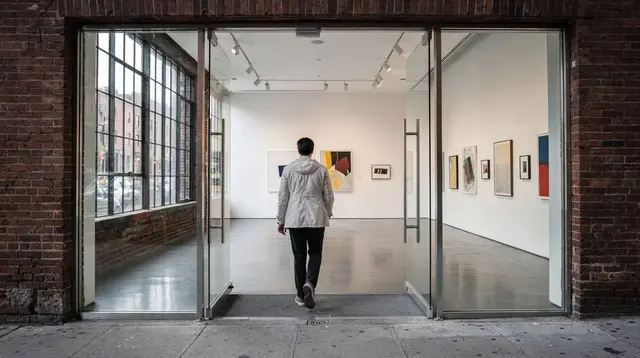
For visitors used to museums, stepping into a Chelsea gallery for the first time can feel slightly unfamiliar. There’s usually no front desk demanding a ticket, no coat check, and often just a single staff member seated at a plain desk near the entrance, working quietly on a laptop. You are not expected to buy anything, sign anything, or explain why you’re there — you simply walk in, look at the work on the walls, and leave whenever you’re ready. Most galleries offer a printed price list or checklist near the door if you want details on a specific piece, but picking one up carries no obligation.
Spaces vary enormously in size and mood. Some occupies a single white-walled room the size of a large living room; others sprawl across a full ground floor with soaring ceilings left over from the building’s industrial past. A handful feel almost like small museums, with a single major installation filling the entire room. This unevenness is part of the appeal — you genuinely don’t know what a given doorway will lead to until you step through it, and that unpredictability is very different from the curated, signposted experience of a large institution like the Met.
There is no expectation of quiet reverence the way there might be in a museum’s older-master galleries, but conversations tend to stay at a low volume out of habit rather than any posted rule. Photography is generally tolerated for personal use, though flash photography and photographing every single label is the kind of behavior that can draw a polite word from staff. When in doubt, a quick glance at the desk or a simple question answers most of these unwritten rules faster than guessing.
Combining the walk with the High Line
The High Line runs on an elevated former freight rail line, with its Chelsea section overlapping almost exactly with the gallery district below. The full stretch of park through Chelsea measures roughly 1.5 km, which takes about 30 to 40 minutes to walk at a normal pace without stopping. In practice, most people take considerably longer, since the park has frequent benches, several viewing platforms that jut out over the cross streets, rotating public art installations, and small food and drink kiosks at a few points along the route.
A practical way to combine the two is to treat the High Line as a spine and the galleries as detours: walk a stretch of the park, take a staircase down to street level when a gallery block looks interesting, spend some time gallery-hopping, then climb back up and continue. The park has entrances and exits roughly every block or two through this stretch, so there is no need to commit to either the park or the galleries exclusively — the two can be interleaved as much or as little as you like.
The High Line’s southern end, near 14th-16th Streets, sits close to Chelsea Market and the Meatpacking District, making a longer route possible: galleries in the low-to-mid 20s, then south along the High Line, finishing at Chelsea Market for food. Several guided walking tours are built around close variations of this loop, useful if you’d rather follow a planned route with commentary than assemble one yourself.
a guided walk through the High Line and Chelsea Market, with an option to add entry to the Edge observation deck covers this southern connection well for visitors who want structure rather than free-form wandering. For a version that leans more heavily into food stops along the way, a High Line, Chelsea and Meatpacking District walking tour threads through the same streets with a different focus. Visitors who want to add the Edge’s glass-floor observation deck as a single extra stop can look at a Chelsea and High Line tour with optional Edge entry, and those coming from further afield or wanting a broader West Village connection might prefer a walking tour covering the High Line, Chelsea Market and the West Village in one outing.
None of these guided options are necessary to enjoy the neighborhood — gallery-hopping and the High Line are both entirely walkable independently, for free beyond the cost of getting there — but they suit visitors who prefer a fixed itinerary and a guide’s context over self-directed wandering.
Getting there by subway
The most direct subway access to the gallery district is the 23rd St station on the C/E line, which puts you within a few blocks of most of the addresses between 20th and 27th Streets. From there, it’s a short walk west to Tenth or Eleventh Avenue to reach the core of the district.
If you’re planning to start from the High Line’s southern end instead — useful if you want to walk north through the park before dropping into galleries — the 14th St stations (served by the A/C/E, the L, and the 1/2/3 lines, depending on exactly which entrance you use) put you close to the park’s southern entrances near the Whitney Museum and Gansevoort Street. Either approach works; the choice mostly comes down to whether you’d rather start with galleries and finish on the elevated park, or the reverse.
A simple half-day plan
| Time | Activity |
|---|---|
| Arrive via 23rd St (C/E) | Start gallery-hopping between 20th and 27th Streets |
| ~1.5-2 hours | Wander gallery blocks, ducking into open spaces as they interest you |
| Mid-afternoon | Climb onto the High Line around 23rd-26th Street |
| ~30-40 minutes | Walk south along the High Line through Chelsea |
| End of walk | Exit near 14th-16th Streets for Chelsea Market or the Meatpacking District |
This is only a loose skeleton — the entire appeal of the gallery district is that it rewards improvising rather than following a fixed script. The one fixed constraint worth respecting is the calendar: build this walk for a Tuesday through Saturday, and check specific gallery hours if any particular space is the reason for your visit.
Nearby to combine with this walk
Beyond the High Line itself, Chelsea sits within easy reach of several other free or low-cost things to do worth folding into the same day. The High Line and Chelsea walking tour guide covers the park route itself in more depth, while Chelsea Market’s food and culture scene makes a natural finishing point after a few hours on your feet.
For a comparison of MoMA’s free evening hours against paid daytime admission, see the MoMA free evening hours guide, and for the Met’s often-misunderstood pricing policy, the Met “pay what you wish” rules guide is worth reading before you go. Visitors building a longer museum-focused day might also want the Museum Mile guide to the Upper East Side for context on how Chelsea’s compact, free gallery scene differs from that more traditional, ticketed museum corridor further uptown.
Weather is worth a thought too, since half of this walk happens outdoors on an elevated, largely unshaded park. A cold, windy day makes the High Line stretch far less pleasant than a mild one, while galleries themselves are, of course, fully indoors and unaffected by the weather — so on a rainy or bitterly cold day, it’s entirely reasonable to flip the balance toward gallery-hopping and treat the High Line portion as optional, saving the elevated walk for a day with better conditions.
Those staying nearby in the Chelsea and High Line area can use this walk as a low-key, no-reservation activity to fill an otherwise open afternoon, and it pairs naturally with wider exploration of Manhattan’s overall layout for first-time visitors still getting their bearings. If your itinerary includes a broader look at things to do in Chelsea and the High Line, this gallery walk is one of the highest-value, lowest-cost entries on that list.
Travelers planning several days in the city more generally may also find the how many days to see New York City guide useful for slotting a Chelsea afternoon into a wider schedule, alongside the Central Park walking tour guide if a second free, self-guided walk appeals on another day. For visitors curious about SoHo’s own, smaller gallery scene by comparison, the SoHo independent galleries guide is a useful next stop.
Museums & Galleries
Verified deep-linked GetYourGuide tours. Book through these links and we earn a small commission at no cost to you.
GetYourGuide does not provide a product photo for this activity — the image shows the meeting point, photographed by us.