Edge at Hudson Yards: The Observation Deck Ticket Explained
Does the Edge ticket include the glass floor and the City Climb?
The standard Edge ticket includes the outdoor observation deck and its partial glass floor section. City Climb, the roped ascent of the building's exterior structure, is a completely separate product with its own ticket, price, and its own weight, height and age restrictions.
What Edge actually is
Edge is the outdoor observation deck at the top of 30 Hudson Yards, one of the newest towers to rise over Manhattan’s West Side. It sits roughly 345 metres (1,131 feet) above street level, at the northern end of the High Line, the elevated park that ends its route right at the base of the building. That location matters more than it might seem: Edge is one of the few major observation decks reachable directly on foot from another major attraction, and the deck’s own outdoor design sets it apart from the fully enclosed decks elsewhere in the city.
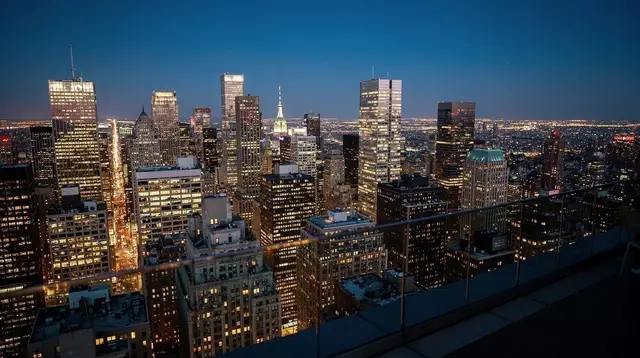
Unlike the Empire State Building or Top of the Rock, which combine indoor viewing galleries with smaller outdoor sections, Edge is built as an entirely open-air platform, angled outward from the building’s face. The deck’s glass walls lean out at an angle rather than standing vertical, which is what produces the sensation, in photographs and in person, of standing over open space rather than behind a railing looking out. This is a deliberate design choice, not a side effect, and it is the main reason Edge photographs so well at sunset with the Hudson River and New Jersey in the background.
The view runs west over the Hudson River toward New Jersey, and south down the spine of Manhattan toward the Financial District and One World Trade Center. On a clear day the Statue of Liberty is visible in the distance to the south. Because Edge sits on the far west side of Midtown, the immediate foreground is the Hudson Yards development itself and the rail yards it was built over, rather than the dense street grid you get looking down from a more central tower.
The standard ticket: what it includes and what it does not
The base Edge ticket is admission to the outdoor observation deck for a specific, pre-booked time slot. That ticket includes access to the deck itself and its partial glass floor section, where a defined area of the platform is transparent underfoot rather than solid. It is worth being precise about that section: the glass floor is one clearly bounded part of the deck, not the entire platform. The rest of Edge’s floor is a standard solid surface with glass panels and railings at the perimeter, so visitors who are not comfortable standing over the transparent section can enjoy the rest of the deck without ever stepping onto it.
Two things are commonly and incorrectly assumed to be part of the standard ticket, and both are worth stating plainly before you book anything.
The first is City Climb. This is a separate, much pricier experience in which small groups, harnessed to an overhead safety line and wearing a purpose-built jumpsuit, climb the angled steel lattice that rises above the Edge deck itself, reaching a point higher than the observation platform below. City Climb is sold, scheduled and staffed entirely independently of the standard Edge ticket.
It has its own minimum height, maximum weight, and minimum age requirements, none of which apply to a standard Edge observation deck visit, and none of which are waived or adjusted based on what you booked for Edge itself. Buying an Edge ticket does not put you anywhere near the City Climb queue, and buying a City Climb ticket does not automatically include separate all-day access to the Edge deck below unless the specific package you booked says so.
The second is any champagne, sunset-toast, or bar package advertised alongside Edge tickets. These are add-ons layered on top of the base admission price, not features baked into the standard ticket. If a listing mentions a champagne toast or a reserved sunset experience, read the inclusions carefully: in most cases that is a specific upgraded product, priced and booked as its own line item, rather than something every visitor to Edge automatically receives.
book a standard Edge observation deck ticket for the base experience described above, without assuming City Climb or any drink package comes with it.
Booking a time slot
Edge sells entry in fixed time slots rather than as an open walk-up ticket, and this is the detail that trips up visitors who assume any observation deck can be visited on a whim. Slots are released for booking in advance, and the popularity of a given slot varies enormously by time of day. Sunset, and the roughly 30 to 60 minutes on either side of it, is consistently the busiest and first-to-sell-out window, particularly on weekends, in the warmer months, and around holidays. If a sunset view over the Hudson is the whole point of your visit, book that specific slot as early as your travel dates allow, ideally days or weeks ahead rather than the morning of.
Slots earlier in the day and mid-afternoon are typically easier to get on shorter notice and come with their own advantage: clearer long-distance visibility in many conditions, since haze tends to build over the course of a hot afternoon. A late-morning or early-afternoon visit also tends to mean shorter waits inside the building once you arrive, since the crowd curve rises steadily toward sunset.
| Time of day | Typical crowd level | What you get |
|---|---|---|
| Morning | Low to moderate | Clearer air, shorter lines, softer light |
| Midday | Moderate | Good visibility, steady foot traffic |
| Late afternoon | High | Warm light building toward sunset |
| Sunset | Highest, sells out first | The signature view, over the Hudson and the skyline |
| After dark | Moderate | City lights, cooler temperatures outdoors |
Because Edge is fully outdoors, weather is a real factor in a way it is not for an indoor deck: high wind, heavy rain, or storms can affect the experience or, in extreme cases, lead to a closure or delayed entry. Checking the forecast for your booked slot the day before is a reasonable precaution, and it is worth confirming the venue’s own policy on rebooking in bad weather rather than assuming a full refund is automatic.
Getting there: on foot from the High Line, or by subway
Edge’s location at the northern terminus of the High Line makes a walk along the elevated park the natural way to arrive if you are already exploring Chelsea. Starting the High Line at its southern end near the Meatpacking District and walking its full length north brings you out directly at the base of the Hudson Yards complex, with Edge’s entrance a short walk from the park’s final staircase. This route also passes Chelsea Market and the gallery block of West Chelsea, so it works well as a half-day combined itinerary rather than a single-purpose trip.
By subway, the closest stop is 34th St-Hudson Yards, the western terminus of the 7 line, which puts you inside the Hudson Yards complex itself within a few minutes’ walk of the Edge entrance. This is the most direct transit option from Midtown and from stations along the 7 line further east, including connections from Grand Central and Times Square.
A walking tour that ties the neighborhood together before your Edge visit can be a useful way to understand what you are looking at once you get to the top: a guided walk through Hudson Yards covering the district’s design and history before heading up to Edge gives the deck’s view some context that is easy to miss visiting cold.
Edge versus the city’s other observation decks
New York has several competing observation decks, and the honest answer to “which one should I pick” depends on what kind of view and what kind of experience you want, not on which is objectively best. Edge’s case rests on being fully outdoors, on its far-west-side position with unobstructed Hudson River views, and on its unusual glass floor section and angled walls.
Top of the Rock, in the middle of Midtown, gives a more central view that includes the Empire State Building itself in the foreground, along with a large open-air deck. One World Observatory, downtown at One World Trade Center, is taller than Edge and gives the widest possible view over the harbor and both rivers, but is entirely indoors.
Summit One Vanderbilt, near Grand Central, leans into immersive art installations and mirrored rooms as much as the view itself. None of these is a strict upgrade or downgrade from Edge; they show different slices of the city from different vantage points, and it is entirely reasonable to visit more than one on the same trip if observation decks are a priority.
If Edge’s price feels steep against a tight schedule, several tours bundle it with a wider look at the neighborhood rather than treating the deck as a stand-alone ticket. A combined option such as a Hudson Yards and High Line walking tour with an optional Edge ticket add-on lets you decide how much time and budget to give the deck itself versus the surrounding area, without pre-committing to the full combination before you have seen either.
Practical costs to plan around
Ticket prices for Edge vary by date, time slot and how far in advance you book, with sunset slots typically priced at or near the top of the range. As with most major New York attractions, the sticker price does not include the city’s 8.875% sales tax, which is added at checkout, and standard admission does not include City Climb, any champagne package, or food and drink purchased on-site, all of which are separate charges.
Budgeting for a visit to Edge is worth doing alongside a wider look at nearby paid attractions if you plan to see more than one observation deck or museum on the same trip; a comparison of the city’s various all-in-one sightseeing passes can clarify whether bundling makes financial sense for your specific itinerary, covered in more detail in the guide to comparing CityPASS and the New York Pass.
Combining Edge with the rest of the neighborhood
Because Edge sits inside the Hudson Yards retail and dining complex, a visit rarely needs to be a single stand-alone stop. The surrounding mall holds dozens of restaurants and shops at street level and several floors up, useful for a meal before or after your timed slot without leaving the building. Just outside, Hudson Yards’ public plaza and the now-familiar honeycomb-shaped Vessel structure anchor the open space at the foot of the towers, worth a few minutes even if you are not stopping inside any of the surrounding buildings.
For visitors building a longer day around the far West Side, a private option covering the full stretch from the High Line through Chelsea and into Hudson Yards removes the guesswork of routing and timing it yourself: a private guided tour through the High Line, Chelsea and Hudson Yards including Edge is worth considering if you would rather have a guide sequence the neighborhood, the park, and the deck into one afternoon.
Those extending the day further west and out of the city entirely sometimes pair a Hudson Yards afternoon with an early start the next morning toward Long Island or the wine country of the North Fork; if that is on your itinerary, a guided option such as a day trip from New York City to the wineries of Long Island’s East End is a common way to structure it, departing well outside the observation deck’s own peak sunset hours.
Planning your visit around the rest of Manhattan
Edge works well as either the finishing point of a High Line walk or as a dedicated half-day outing tied to Hudson Yards itself. Visitors building a broader Midtown and West Side day sometimes stack it against other paid attractions to make the most of a single afternoon; a look at how Edge compares directly against Top of the Rock and other decks, alongside the general question of how many days to spend in New York, can help decide whether one observation deck is enough or whether the trip justifies two.
For a first-time visitor mapping out where Edge fits against Manhattan’s other major sights, the Chelsea and High Line destination guide lays out the wider neighborhood, while the walking tour of the High Line and Chelsea covers the route on foot in more detail than a subway-only visit would show you.
Edge and Hudson Yards, in short
Edge earns its place on a Manhattan itinerary through its outdoor design, its far-west vantage over the Hudson River, and the novelty of its glass floor section, not through being taller or more central than its competitors. The ticket that gets you onto the deck is a specific, time-slotted, standard admission; City Climb, champagne packages, and sunset upgrades are each their own separate purchase, priced, restricted, and booked apart from that base ticket. Booking the right slot for the view you actually want, and pairing the visit with a High Line walk either before or after, makes for one of the more efficient half-days on the West Side.
Observation Decks
Verified deep-linked GetYourGuide tours. Book through these links and we earn a small commission at no cost to you.
GetYourGuide does not provide a product photo for this activity — the image shows the meeting point, photographed by us.
9/11 Ground Zero Tour with Optional One World Observatory

Private Downtown All Access One World Observatory 9/11 Memorial Statue of Liberty and Ellis Island