Walking the Brooklyn Bridge: The Complete Guide
Do you need a guided tour to walk the Brooklyn Bridge?
No. The Brooklyn Bridge pedestrian walkway is free, open 24 hours, and follows one straight, clearly signed path, so a paid tour is not necessary to complete the crossing. It runs about 1.8km between the Manhattan side near City Hall and the Brooklyn side in DUMBO, and takes roughly 30-40 minutes walking straight through.
Why this crossing needs no ticket, no app and no plan
The Brooklyn Bridge is one of the few genuinely great things to do in New York that costs nothing and requires no advance booking of any kind. The pedestrian walkway runs down the center of the bridge, elevated above the traffic lanes, for about 1.8km between an access point on the Manhattan side near City Hall and an access point on the Brooklyn side in DUMBO. Walked straight through, without stopping, it takes roughly 30-40 minutes. Almost nobody walks it straight through, because the views in both directions, of the Manhattan skyline, the East River, and the Statue of Liberty in the far distance, are worth stopping for.
This guide covers the practical side of the crossing: where the two ends actually are, how the shared bike-and-pedestrian lane works and why it causes so many near-misses, when the bridge is quiet versus jammed, and what to expect on arrival in DUMBO. None of it requires a guide, and this page is not going to pretend otherwise.
The route: Manhattan to Brooklyn, or Brooklyn to Manhattan
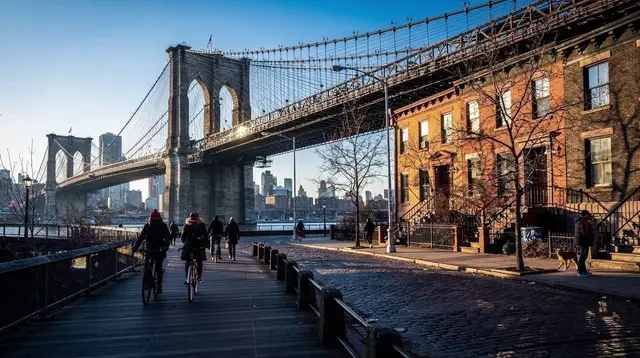
The Manhattan-side entrance sits near City Hall Park, close to the Financial District, a short walk from the 4/5/6 and J/Z subway lines at Brooklyn Bridge-City Hall station. Stairs and a ramp lead up to the elevated walkway, which then runs in a straight, unbroken line the entire length of the bridge. There is no branching, no detour and no way to get lost: the path goes one way, down the middle of the span, until it descends into Brooklyn.
The Brooklyn-side entrance drops walkers into DUMBO, close to the neighborhood’s cobblestone streets, its clustered shops and cafes, and the waterfront beyond. Walking Manhattan to Brooklyn means the crossing ends somewhere genuinely worth arriving in; walking the reverse direction ends in the denser government-building blocks around City Hall, which is a fine option too but a less rewarding final few minutes for most visitors.
Either direction is 1.8km one-way, so the standard approach is to walk one way and either walk back or take the subway back from the other side. A full there-and-back on foot works fine for a relaxed morning or afternoon.
| Segment | Approximate distance | Straight-through walking time |
|---|---|---|
| Manhattan access to bridge tower (first tower) | ~0.5km | 8-10 minutes |
| Between the two towers (mid-span) | ~0.5km | 8-10 minutes |
| Bridge tower to Brooklyn/DUMBO access | ~0.8km | 12-15 minutes |
| Full crossing, one way | ~1.8km | 30-40 minutes |
Add photo stops, and a comfortable one-way pace runs closer to 45-75 minutes.
The bike lane problem: read the paint on the deck
The single biggest practical issue on the Brooklyn Bridge walkway is not crowding, weather, or navigation — it is the shared lane. The wooden promenade is split into two lanes running side by side: one for pedestrians, one for cyclists, separated by a painted line and marked at intervals with stenciled bicycle symbols on the deck surface. This is not a suggestion; it is an active commuter cycling route as well as a tourist attraction, and cyclists use it at real speed, particularly outside the busiest tourist hours.
Minor collisions happen constantly, almost always for the same reason: a pedestrian stops mid-stride to take a photo, glances at a phone, or simply drifts sideways without noticing the change in the deck markings underfoot, and steps into the bike lane just as a cyclist is passing. The fix is simple and requires no special awareness beyond the obvious: look down before stopping, glance behind before crossing into the other lane, and keep group photos and selfie pauses tucked to the pedestrian side rather than spread across the full width of the deck. Cyclists ring bells and call out, but on a crowded bridge that warning often arrives too late to matter.
A short history of the two stone towers
The Brooklyn Bridge is as much a 19th-century engineering landmark as it is a way to get from Manhattan to Brooklyn, and that history is visible in the two Neo-Gothic stone towers that anchor the span and give the walkway its distinctive silhouette in every skyline photo. The towers, laced together by the web of steel cables that still carries the deck, were among the largest masonry structures built in the country at the time, and walking directly beneath them on the elevated promenade is the closest most visitors get to that engineering up close, since the cables and cross-bracing are only a few meters overhead at the midpoint of the crossing.
None of that history is necessary to know in order to cross the bridge, but it explains why the walk draws architecture and engineering enthusiasts as well as sightseers, and why the stretch between the two towers is consistently the busiest photo spot on the entire 1.8km walkway. Travelers who want the full story, told by a guide rather than pieced together from plaques, will get more out of it than reading it here; the guided options in the section above cover that layer without adding anything to the price of simply crossing on your own.
When to go: crowds build by mid-morning and stay late
The Brooklyn Bridge has no closing time and no capacity limit, which means crowd levels swing hard across the day. Late morning through mid-afternoon is consistently the busiest window: tour groups, cruise-ship day-trippers, school groups and casual sightseers all converge on the same narrow elevated walkway at once, and photo bottlenecks form at both towers, where nearly everyone stops for the same shot.
Two windows are reliably calmer:
- Early morning, roughly before 9am, when the light is good, the temperature is more comfortable in summer, and the walkway is shared mainly with commuters cycling or walking to work rather than tour groups.
- Late afternoon into early evening, particularly the hour or so before sunset, when day-trip crowds have thinned and the bridge cables and towers catch the low light.
Midday on a weekend, especially in the warmer months, is the single worst combination: peak tourist volume, peak heat, and peak bike traffic all overlapping on the same 1.8km strip. If flexibility allows it, shifting the crossing to one of the quieter windows changes the experience substantially, from a shuffling, photo-stop-every-ten-meters crawl to an actual walk.
Crossing after dark
The walkway’s 24-hour access means the bridge is also a legitimate option after sunset, not just for the golden-hour window covered above. The deck is lit for the full length of the crossing, the path is exactly as straight and unbranching at night as during the day, and the skyline views, particularly looking back at lower Manhattan’s lit towers from mid-span, are a genuinely different experience from a daytime crossing. It is also noticeably quieter: most day-trip groups and tour buses are gone by early evening, leaving the walkway mainly to a mix of commuters, joggers and a smaller number of visitors specifically timing a night crossing.
The same practical points apply after dark as during the day, only more so: wind is colder and more noticeable with no sun to offset it, the wooden deck is just as capable of being slick if it has rained, and the bike lane still carries commuter traffic that is easy to miss in lower light. A guided evening or sunset option, such as the NYC Brooklyn Bridge Guided Walking Tour to DUMBO, bundles the timing and the storytelling together for travelers who would rather not plan the exact sunset window themselves.
Arriving in DUMBO
The Brooklyn-side descent puts walkers directly into DUMBO’s small grid of cobblestone streets, home to galleries, bookstores, and the neighborhood’s well-known view corridor down Washington Street toward the Manhattan Bridge. From the bridge’s Brooklyn approach, the Manhattan Bridge is visible a few blocks north, running parallel across the East River, and the two bridges together give DUMBO much of its visual identity.
Brooklyn Bridge Park sits just below and around the bridge’s Brooklyn landing, a long waterfront park with lawns, piers and a direct view back up at the underside of the bridge. It is a natural place to sit down after the crossing, and a good vantage point for photographing the bridge itself from ground level rather than from the walkway.
For a more structured look at the neighborhood beyond the bridge, see the DUMBO and Brooklyn Heights promenade guide, which covers the waterfront path, the Brooklyn Heights side streets, and the classic photo spot at the corner of Washington and Water Streets.
Do you need a guided tour?
For the crossing itself, no. The walkway is one continuous, well-signed path with no navigation decisions to make, and every fact a first-time visitor needs, where the entrances are, which lane is which, when it’s quiet, is covered by this page. Paying for a guide is not required to walk from one side to the other.
Where a guide adds real value is context: the bridge’s construction history, the engineering behind its stone towers and steel cables, and the neighborhood stories on either end are easy to miss walking solo. A short guided option worth considering for that layer of detail is the NYC: Brooklyn Bridge DUMBO Walking Tour, which pairs the crossing with a guided look at DUMBO on the other side. Travelers who want to fold in more of Brooklyn beyond DUMBO in the same outing might prefer the New York: Best of Brooklyn 2 Hour Walking Tour, which extends past the bridge into the wider neighborhood.
Groups or travelers who’d rather set their own pace but still want a knowledgeable guide along for the DUMBO half can look at the Brooklyn Bridge: DUMBO Neighborhood Walking Tour, and those wanting a private, unhurried version of the same route, useful with kids or for photography-focused visits, can consider the Private Guided Walking Tour of the Brooklyn Bridge and DUMBO. None of these are necessary to simply walk across; they exist for travelers who want narration and structure layered onto a crossing that works perfectly well without one.
What to check before you go
The bridge deck sits well above the East River with essentially no windbreak, so conditions up there are noticeably harsher than at street level. Wind that feels mild on the sidewalk below can be sharp and constant on the walkway, and rain offers no shelter for the full 1.8km. Checking the forecast, and specifically the wind forecast rather than just temperature, before setting out avoids an unpleasant surprise partway across with nowhere to wait it out.
Footwear matters more than most visitors expect: the walkway surface is wooden planking, uneven in places, and can be slick when wet. Comfortable, closed shoes make a meaningfully better crossing than sandals, especially in the two crowded stop-and-start zones near each tower.
What this walk is not
This is not a fast, empty, obstacle-free stroll at any hour a visitor happens to show up. During late morning and afternoon, especially on weekends and in peak season, the walkway is genuinely crowded, and progress across it slows to a shuffle punctuated by photo bottlenecks at both towers. Anyone told to expect a brisk, unimpeded 30-minute walk regardless of when they go has been given bad information; the 30-40 minute figure is a straight-through pace on a clear walkway, not a guarantee at 2pm on a Saturday in June.
It is also not a crossing that requires a paid guide to complete. The route is a single signed path with one direction of travel, and every practical detail needed, entrance locations, lane markings, crowd timing, is covered above. A guide adds context and storytelling, not navigational necessity.
Combining the walk with more of Brooklyn
The bridge crossing is naturally a starting point rather than a destination in itself, and most visitors who make it to DUMBO end up wanting to see more of Brooklyn the same day. Williamsburg, a few subway stops or a longer waterfront walk north, extends the same East River views with a different, more residential neighborhood feel, and the Williamsburg walking tour guide covers how that stretch fits into a fuller Brooklyn day. Closer to the bridge itself, Downtown Brooklyn and Brooklyn Heights offer a quieter, brownstone-lined contrast to DUMBO’s cobblestones within a ten-minute walk of the Brooklyn-side landing.
For travelers who’d rather have a guide connect these pieces rather than stitch together a route on foot, the Manhattan vs. New York City overview is a useful primer on how the boroughs relate to each other before deciding how much of Brooklyn to add on. And for a single outing that folds the crossing itself into a broader look at the borough on foot, the Brooklyn Bridge and DUMBO Walking Tour covers both halves in one booking rather than requiring a separate plan for each side.
Planning the rest of the day around it
The Brooklyn Bridge crossing pairs naturally with a longer look at DUMBO and neighboring Brooklyn, and fits well into a broader day that also covers the Financial District on the Manhattan side before crossing.
Visitors building a first full day around lower Manhattan and Brooklyn together can check the one-day Manhattan essentials itinerary or the two-day Manhattan and Brooklyn itinerary for how the crossing slots into a wider plan, and the Brooklyn Bridge and DUMBO walking tour guide and brooklyn bridge bike tour for related ways to cover the same ground, on foot or by bike, at a different pace.
Brooklyn Tours
Verified deep-linked GetYourGuide tours. Book through these links and we earn a small commission at no cost to you.
GetYourGuide does not provide a product photo for this activity — the image shows the meeting point, photographed by us.