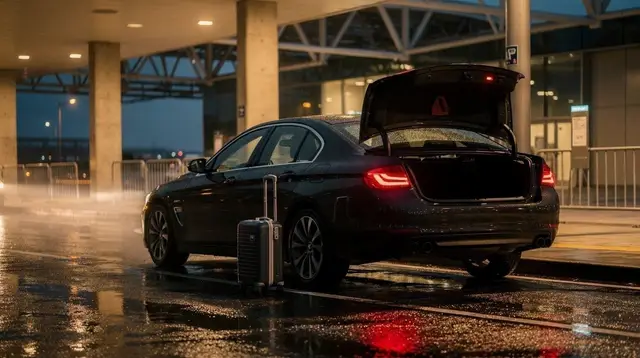
LaGuardia Airport Transfer: Taxi, Private Car and Bus Options
What is the best way to get from LaGuardia Airport to Manhattan?
A metered taxi or a pre-booked private transfer are the most practical options, typically $40-65 to Manhattan before tolls and tip, taking 30-60 minutes depending on traffic. Unlike JFK, LaGuardia has no flat-rate taxi fare and no AirTrain of its own, so public transit means a bus connection to the subway rather than a direct rail link.
Getting from LaGuardia to Manhattan
LaGuardia Airport (LGA) sits in Queens, closer to Manhattan as the crow flies than JFK, but it does not come with the flat-fare taxi system or the direct rail connection that make JFK relatively predictable to plan around. Anyone arriving at LaGuardia needs a different mental model: metered fares, variable traffic, and a bus-to-subway combination rather than a one-seat train ride. None of that makes it a hard airport to leave — it just rewards knowing the actual mechanics before you land, rather than assuming it works like the other two regional airports.
This guide covers the realistic options for reaching Manhattan (and the reverse trip back to LaGuardia): metered taxis, pre-booked private transfers, rideshare apps, and the public bus-and-subway route. It also clears up two points that get mixed up constantly online — the flat-fare myth and the AirTrain myth — because both lead travelers to expect something LaGuardia genuinely does not offer.
Why LaGuardia is not JFK: no flat fare, no AirTrain
Two features that make JFK relatively easy to budget for simply do not exist at LaGuardia.
First, JFK has a city-regulated flat taxi fare to Manhattan, a fixed dollar amount set by the New York City Taxi and Limousine Commission regardless of traffic. LaGuardia does not have this. Every taxi trip from LaGuardia runs on the meter, start to finish, which means the fare climbs if the driver hits traffic on the Brooklyn-Queens Expressway, the Grand Central Parkway, or the local streets feeding into Manhattan. There is no dollar figure a driver can quote you at the curb that is guaranteed by regulation the way JFK’s fare is.
Second, JFK and Newark both have their own AirTrain systems — automated people-movers that connect airport terminals to a regional rail or subway station, where a further paid fare takes you onward. LaGuardia still has no AirTrain of its own. Plans for one have been discussed for years, but as of 2026 nothing has opened. The only way to reach a subway station from LaGuardia by public transit is a bus first.
Confusing these two points leads to two common disappointments: travelers who expect a fixed LaGuardia taxi fare and are surprised by a meter running higher than planned in heavy traffic, and travelers who look for a LaGuardia AirTrain sign that does not exist. Neither is a flaw in planning if you know it going in — it just means budgeting a range for the taxi, and adding a bus leg if going by transit.
Taxi from LaGuardia: what to actually expect
A yellow taxi from LaGuardia’s official taxi stand is straightforward to find and use, and the ride to Manhattan is metered the whole way. Realistic fares run roughly $40-65 depending on traffic conditions, time of day, and exactly where in Manhattan you are headed — a trip to Midtown is a different distance and traffic profile than one to Lower Manhattan or the Upper East Side. That range does not include tolls on any bridge or tunnel the route crosses, and does not include a tip, which is customary at around 15-20% of the metered fare.
Trip time is typically 30 to 60 minutes, but that window can widen considerably during rush hour, bad weather, or an incident on one of the connecting expressways. A late-afternoon taxi from LaGuardia during a Friday rush hour can easily take longer than a ride that would be quick at 10am on a Tuesday. If you are working against a flight, a show, or any fixed appointment, build in a real buffer rather than assuming the lower end of that range.
Taxis queue at an official taxi stand outside the terminals, with airport staff directing passengers into the line — there is no need to pre-arrange a yellow taxi, and no legitimate way to skip the line by paying extra.
Private transfer: a pre-booked, fixed-price alternative
For travelers who would rather know the exact price before landing, and skip both the taxi line and any rideshare surge pricing, a pre-booked private transfer is worth considering. A driver typically waits in the arrivals area with a name sign, takes you directly to your Manhattan address, and charges the price agreed at booking rather than a meter that can climb in traffic.
A shared transfer between LaGuardia and Manhattan hotels is a lower-cost option that shares the vehicle with other passengers, useful if your schedule has some flexibility and you’re not in a hurry to reach your hotel directly.
For a private vehicle with no other stops, a private limousine transfer (also configurable for LaGuardia routing) or a Midtown Manhattan transfer covering LaGuardia, JFK or Newark gives you a dedicated car and driver, useful for groups, families with luggage, or late-night arrivals when taxi lines and rideshare surge pricing can both be at their worst.
Either way, booking ahead removes the two biggest sources of taxi-fare uncertainty — traffic-driven meter climbs and no fixed number to plan around — in exchange for a flat price agreed before you land.
Rideshare apps: available, but priced dynamically
Uber, Lyft and similar apps operate at LaGuardia, picking up from a designated rideshare area at the terminals. Fares are calculated by each app’s own algorithm based on real-time demand, which means they can run below a typical metered taxi fare at quiet times, or well above it during surge pricing around peak arrival banks, bad weather, or major events in the city. There is no fixed relationship between a rideshare fare and the taxi fare at any given moment — check the app’s price estimate before confirming a ride rather than assuming it will undercut a taxi.
Public transit: the Q70 bus to the subway
The most budget-conscious way to leave LaGuardia is the Q70 Select Bus Service, which is free to ride and connects the airport terminals to two subway stations in Queens: 74th St-Broadway/Jackson Heights and Roosevelt Av/Jackson Heights. From either station, you can transfer to the 7, E, F, M or R subway lines into Manhattan, paying the standard subway fare from that point ($2.90 as of 2026, via OMNY tap or MetroCard).
This route takes considerably longer than a taxi or private transfer — typically well over an hour door to door once you account for the bus ride, the transfer, and the subway leg into Manhattan — and is a poor choice with heavy luggage, since it involves stairs and platform transfers with no dedicated luggage space.
It’s a genuinely useful option for a light bag and a flexible schedule, and a much less practical one for a family with suitcases trying to reach a hotel directly. For the fuller picture across all three regional airports, see the combined JFK, LaGuardia and Newark airport transfer guide and the OMNY and MetroCard guide for how subway fares and passes actually work.
Comparing your options at a glance
| Option | Typical cost | Typical time | Best for |
|---|---|---|---|
| Metered taxi | $40-65 + tolls + tip | 30-60 min | Straightforward, no pre-booking needed |
| Private transfer | Fixed price, agreed at booking | 30-60 min | Predictable pricing, groups, late arrivals |
| Rideshare (Uber/Lyft) | Varies with demand | 30-60 min | Flexible, but check price before confirming |
| Q70 bus + subway | $2.90 (subway fare only) | 60-90+ min | Light luggage, flexible schedule, lowest cost |
LaGuardia versus JFK and Newark
It helps to see LaGuardia’s quirks next to the other two regional airports rather than in isolation. JFK, in Queens like LaGuardia, has a city-regulated flat taxi fare to Manhattan and its own AirTrain connecting to the subway and Long Island Rail Road. Newark, across the Hudson in New Jersey, also has an AirTrain, linking to a rail station with NJ Transit and Amtrak service into Manhattan, though its taxis run on the meter rather than a flat fare. LaGuardia is the outlier of the three: no flat fare, no AirTrain, and the only one of the three regional airports where a bus is the mandatory first leg of any transit journey to the subway.
None of the three airports is objectively “the easy one” for every traveler — JFK’s flat fare is predictable but the airport itself is farther out; Newark’s AirTrain-to-rail link is efficient but requires crossing state lines; LaGuardia’s proximity to Manhattan can be offset by traffic and its lack of direct rail. Knowing which quirks apply to which airport before you land is what actually saves time and money, rather than assuming one system works like another.
Practical tips for a LaGuardia arrival
Have your destination address ready before you reach the taxi stand or rideshare pickup point — drivers appreciate not having to look it up, and it speeds up dispatch during busy periods. If you’re catching a flight rather than arriving, LaGuardia’s TSA lines can back up at peak morning and early-evening departure banks, so a taxi or private transfer booked with a wide buffer is safer than cutting it close, particularly given how variable the road traffic into the airport can be.
And if your itinerary also touches JFK or Newark on the same trip — a common pattern for connecting flights or a multi-city visit — it’s worth reading the combined airport transfer guide once rather than re-deriving each airport’s rules from scratch. The JFK, LaGuardia and Newark to Manhattan transport breakdown covers the same ground from a slightly different angle, comparing all three airports side by side rather than treating LaGuardia in isolation.
Reaching specific parts of the city from LaGuardia
Where exactly you’re headed changes both the taxi fare and the sensible option to pick. A trip into Manhattan generally means one of the routes above, but the borough is large enough that the destination within it matters. Heading to Midtown or the theater district keeps the ride relatively short; continuing on to Greenwich Village or SoHo adds distance and, often, denser traffic once you’re off the expressway and onto Manhattan’s downtown streets. The Upper East Side, close to Central Park and Museum Mile, is a comparatively direct run from LaGuardia via the Grand Central Parkway, while Harlem at the island’s north end can actually be quicker than a Midtown drop-off outside of rush hour.
LaGuardia is not only a gateway to Manhattan. It sits in Queens itself, so a taxi or rideshare to a Queens neighborhood like Astoria or Long Island City is a short, often inexpensive hop rather than a full cross-borough trip. Travelers headed to Brooklyn — say, a hotel near DUMBO or Williamsburg — should expect a longer, more traffic-dependent ride than the Manhattan figures above, since the route typically threads through Queens and across one of the East River crossings; a private transfer with a fixed price can be worth the extra certainty on that particular route. A trip to Staten Island or deep into the Bronx is longer still and rarely worth a metered taxi — a private transfer or a well-planned transit combination usually makes more sense.
LaGuardia within a longer New York itinerary
Most travelers only think about LaGuardia’s transfer logistics once, at the start and end of a trip, which makes it easy to under-plan. If this is your first visit and you’re still sketching out how many days to spend and where, the how many days to see New York City guide and the three days: classic New York itinerary are useful starting points that assume exactly this kind of airport-to-hotel-to-sightseeing arc. Families landing at LaGuardia with young kids in tow may find the New York City with kids itinerary and the family-friendly five-day itinerary helpful for pacing the rest of the trip once the transfer itself is sorted.
If your visit to New York is really the first stop on a wider Northeast trip — on to Boston, Philadelphia or Washington DC by train — LaGuardia’s transfer is really just the opening leg, and the seven days by train through the Northeast itinerary lays out how those legs connect. And for the budget-minded, the real daily budget for New York City breakdown is worth reading alongside this guide, since the airport transfer is often one of the larger single line items in a short trip’s transportation costs.
For groups or families who’d rather book one fixed-price ride and not think about tolls, meters or bus transfers at all, a one-way shared transfer between hotels and the airport covers LaGuardia alongside JFK and Newark, which is convenient if your travel dates aren’t fully locked in when you book.
Whichever option you choose, the core fact to plan around is simple: LaGuardia runs on the meter, not a flat rate, and reaches the subway by bus, not by its own train. Budgeting for that reality, rather than for what JFK or Newark offer, is what keeps a LaGuardia transfer from becoming a surprise.
Getting Around
Verified deep-linked GetYourGuide tours. Book through these links and we earn a small commission at no cost to you.
GetYourGuide does not provide a product photo for this activity — the image shows the meeting point, photographed by us.