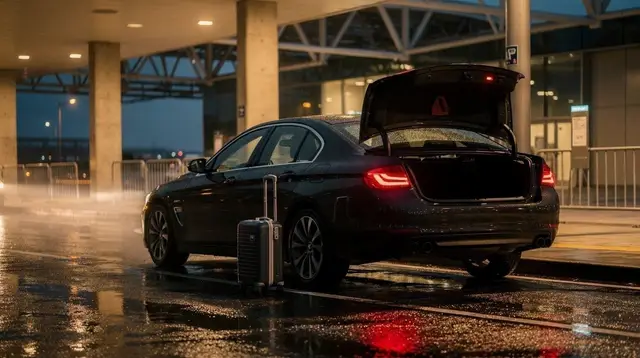
Newark Airport to Manhattan: Private Transfer Guide
What is the best way to get from Newark Airport to Manhattan?
A private car or licensed taxi runs on the meter, roughly $70-90 plus tolls and tip to Manhattan, taking 30-50 minutes outside rush hour. The AirTrain is free only between terminals and the airport's own rail station; the onward NJ Transit or Amtrak ride into Penn Station is a separate ticket, around $15.
Newark Liberty International Airport (EWR) sits across the Hudson River in New Jersey, which throws off a lot of first-time visitors who assume it works exactly like JFK or LaGuardia. It doesn’t, in one important way: Newark has no flat taxi fare into Manhattan. Every car ride from Newark, whether a yellow-style taxi, a private transfer, or a ride-hailing app, is priced on the meter or by the app’s own algorithm, moving with traffic, tolls and time of day rather than a number fixed in advance.
That single fact shapes almost everything else in this guide, so it’s worth stating plainly before going further: if you’ve read that Newark has a flat fare like JFK, that’s wrong. JFK is the outlier of the three regional airports, not the norm.
How the flat-fare myth spreads, and why Newark is different
New York’s three major airports get talked about as a set so often that features of one quietly get assumed to apply to all three. JFK, in Queens, has a genuine city-set flat fare for yellow taxis heading into Manhattan, a fixed number regardless of traffic. LaGuardia, also in Queens, has no such flat fare, and neither does Newark. Both run on the meter.
For Newark specifically, that means the fare you pay depends on:
- Traffic conditions at the time of travel, especially around the Lincoln and Holland Tunnels
- Tolls, charged separately and added to the fare rather than built into it
- The specific Manhattan address, since a Financial District drop-off is a different distance than one on the Upper West Side
- Time of day, with weekday rush hours (roughly 7-10am and 4-7pm) adding real time and, for app-based rides, sometimes surge pricing
A private, pre-booked transfer sidesteps some of that uncertainty by quoting a fixed price up front for the specific route, which is part of why travelers who want cost certainty tend to book one rather than gamble on a live meter or app pricing.
What a Newark to Manhattan transfer actually costs
Based on typical 2026 metered and quoted fares, here’s a realistic range for the most common version of this trip: Newark Airport to a Manhattan address.
| Cost element | Typical range |
|---|---|
| Metered taxi or quoted private fare | $70-90 |
| Hudson River tunnel toll (Lincoln or Holland) | Added on top, not included in the fare above |
| Driver tip | 15-20% of the fare, customary but not automatic on a metered taxi |
| AirTrain (terminal to Newark Liberty Airport Station) | Free |
| NJ Transit onward to Penn Station | Around $15 |
Two things worth flagging in that table. First, the $70-90 range is the base ride and does not include the toll or tip, both of which are genuinely separate additions, not folded into a headline number the way marketing sometimes implies. Second, the AirTrain leg looks free because it is, but only for the portion between terminals and the airport’s own train station — it is not a free ride to Manhattan, a point covered in detail below because it causes real confusion.
How long the trip takes
Outside of rush hour, a car from Newark Airport to Manhattan typically takes 30 to 50 minutes, depending on the specific destination and which tunnel the driver uses. During weekday morning or evening rush, or in bad weather, that trip can stretch past an hour, and delays at the tunnel approaches are common enough that anyone connecting to a flight, a show, or a fixed appointment should build in real buffer time.
The AirTrain-plus-train alternative has its own timing profile: a few minutes on the AirTrain from your terminal to Newark Liberty Airport Station, then a wait for the next NJ Transit or Amtrak departure, then roughly 20-30 minutes on the train into Penn Station, then whatever time it takes to get from Penn Station to the final destination in Manhattan, on foot, by subway, or by another car. Door to door, this can be competitive with a car during heavy road traffic, but it involves more steps and more handling of luggage.
The AirTrain: what “free” actually covers
This is the single most misunderstood part of a Newark Airport trip, so it deserves its own clear statement: the AirTrain at Newark is free only between the airport’s own terminals and Newark Liberty International Airport Station, the rail station located on airport property. That’s the entire scope of the free portion.
Getting from that station into Manhattan is not part of the free AirTrain ride. It requires buying a separate ticket on NJ Transit or Amtrak, both of which stop at Newark Liberty Airport Station and run into Penn Station in Midtown Manhattan. NJ Transit is the cheaper of the two, commonly around $15 for this specific leg, while Amtrak covers the same route at a higher fare as part of its longer-distance service.
So the realistic sequence for someone using this route looks like: AirTrain from the terminal (free) to the airport train station, buy an NJ Transit or Amtrak ticket at the station (paid, roughly $15 on NJ Transit), ride the train to Penn Station, then continue from Penn Station by subway, on foot, or by a short additional car ride to a final Manhattan address. Anyone who has read that “the AirTrain gets you to Manhattan for free” has read an incomplete version of how the system actually works — the free segment stops at the airport’s train station, not at Penn Station.
Private transfer vs. taxi vs. train: a practical comparison
| Option | Typical cost | Typical time | Best for |
|---|---|---|---|
| Private pre-booked transfer | Fixed quote, commonly comparable to a $70-90 metered fare, tolls sometimes included in the quote | 30-50 minutes outside rush hour | Arriving with luggage, a fixed schedule, or wanting a driver waiting at arrivals |
| Airport taxi stand | Metered, roughly $70-90 plus tolls and tip | 30-50 minutes outside rush hour | Arriving without a booking and comfortable with a taxi line |
| Ride-hailing app | Varies with app pricing at time of booking, can exceed or undercut a taxi | Similar to taxi, plus pickup wait | Travelers already used to a specific app |
| AirTrain + NJ Transit/Amtrak to Penn Station | Free AirTrain + roughly $15 train ticket | AirTrain minutes + train wait + ~20-30 minute ride + onward travel from Penn Station | Light luggage, budget-conscious travelers, avoiding road traffic |
A private Newark Airport to Manhattan transfer books a fixed price and a driver waiting with your name at arrivals, which removes the guesswork of a live meter and the wait at a taxi stand after a long flight. Travelers connecting onward to LaGuardia or JFK on a later leg, or arriving into either of those airports instead, can look at a Midtown Manhattan transfer covering JFK, LaGuardia or Newark, which is set up for exactly this kind of airport-to-airport or hotel-to-airport routing.
Getting a driver to a specific address
Whichever option is chosen, a few practical points make the pickup smoother:
- Confirm the terminal. Newark has multiple terminals, and a private transfer or taxi pickup point depends on which one a flight lands at; check the confirmation against the arrivals board.
- Have the exact Manhattan address ready. Fares and times both depend on the specific destination, whether that’s a hotel in Midtown, an apartment downtown, or an address further uptown.
- Expect the toll to appear as a separate line. Whether on a metered taxi receipt or a private transfer invoice, the Hudson River tunnel toll is typically itemized rather than baked into the base fare shown at booking.
- Build in extra time around rush hour. The 7-10am and 4-7pm windows on weekdays are when tunnel approaches back up most, and that delay affects a private car exactly as much as a taxi.
Traveling as a family or group
Groups and families weighing a Newark arrival face a slightly different calculation than a solo traveler. A metered taxi or a standard private car is priced per trip rather than per passenger, so splitting the $70-90 base fare across three or four people already narrows the gap with the AirTrain-plus-train option, before even counting the time saved not managing luggage through two changes of transport. For groups arriving on different flights, or travelers who would rather split a ride than book an entire private car, a one-way shared transfer between hotels and the airport is worth comparing against a dedicated private car on cost per person.
Luggage is the other practical variable. A family arriving with car seats, strollers or several checked bags will generally find a private car or taxi easier than the AirTrain and train combination, which involves lifting bags on and off two separate systems and navigating stairs or escalators at Newark Liberty Airport Station and again at Penn Station. Anyone continuing straight to a full day of sightseeing rather than a hotel check-in might also want to look at the Manhattan luggage storage guide or the Penn Station and Grand Central luggage storage guide, both useful if the train option is chosen and a bag needs to be dropped before a same-day itinerary begins. Families planning the arrival day around young kids may also find the five-day family itinerary useful for pacing the rest of the trip after a long travel day.
Departing from Newark: the return trip
Everything covered above for arrivals applies in reverse for a departure, with one addition worth planning for: flight timing. Because the trip from Manhattan to Newark carries the same 30-50 minute range outside rush hour, and the same risk of running past an hour during the weekday windows, a private transfer booked in advance for a departure removes the uncertainty of hailing a taxi with a flight to catch. Building in buffer time matters more for a departure than an arrival, since a late arrival just means a longer wait at baggage claim, while a late departure risks the flight itself.
Travelers who arrived at one airport and are departing from another, a common pattern for multi-city itineraries or when a return flight home is priced differently out of JFK or LaGuardia, can compare the JFK private transfer guide and the LaGuardia airport transfer guide alongside this one. A private limousine transfer to JFK and the JFK private transfer both work the same way as the Newark option covered here: a fixed quote, a driver at the pickup address, and no meter running with traffic. The LaGuardia airport transfer follows the same model for that airport.
Newark within a longer New York itinerary
A Newark arrival or departure rarely stands alone; it’s usually one end of a longer stay in the city, or a stay that includes day trips beyond it. Visitors mapping out how many days to spend before or after using Newark as a gateway may find the how many days to see New York City guide useful for pacing, while the New York City budget planning guide puts the cost of this transfer in context alongside lodging, food and attractions.
For trips that pair a Newark flight with time outside Manhattan itself, whether a day in the Hudson Valley to the north or a stop across the river in New Jersey before or after the flight, the four-day New York and Hudson Valley itinerary and the seven-day Northeast by train itinerary both work a Newark leg into a wider trip. And because the subway, not a car, does most of the work once inside the city, the NYC subway OMNY and MetroCard guide is worth reading before the first ride from a Manhattan hotel.
Comparing Newark to the other two airports
Anyone weighing which New York airport to fly into, or connecting between two of them, benefits from seeing the three side by side. Full detail on all three lives in the JFK, LaGuardia and Newark transfer guide, but the key distinction for Newark is worth repeating here: it is the only one of the three that sits in a different state, New Jersey, across the Hudson from the city, which is why every ground transport option involves either a tunnel toll by car or a train transfer at Penn Station rather than a direct subway connection.
JFK’s transfer options are covered separately in the JFK private transfer guide, and LaGuardia’s in the LaGuardia airport transfer guide, useful if a trip involves flying into one airport and departing from another.
Where a Newark arrival fits into a first visit
For most visitors landing at Newark, the destination is somewhere in Manhattan, whether a hotel near Midtown, a stay closer to Greenwich Village, or a base further downtown near the Financial District. Once settled in, the practicalities of getting around the city by subway are covered in the subway fare guide, which explains OMNY and MetroCard, the two payment systems currently used side by side on the system.
Travelers planning a longer stay that includes day trips beyond the city, to the Hudson Valley or further afield, may also want to check the day trips hub for options that pair naturally with an itinerary bookended by a Newark arrival and departure, since a return trip to Newark faces the exact same fare and AirTrain realities in reverse.
For a full first look at how the city fits together before diving into transport logistics, the New York City overview is a useful starting point, and the airport transfers category collects the full set of transfer options across all three airports for comparison.
Getting Around
Verified deep-linked GetYourGuide tours. Book through these links and we earn a small commission at no cost to you.
GetYourGuide does not provide a product photo for this activity — the image shows the meeting point, photographed by us.