NYC Airport Transfer Guide: JFK, LaGuardia and Newark to Manhattan
What is the best way to get from a New York airport to Manhattan?
From JFK, a yellow taxi charges a flat, city-set fare to Manhattan regardless of traffic. From LaGuardia and Newark, taxis and rideshares run on the meter, so the price varies with congestion. The AirTrain at JFK and Newark is free only between terminals; reaching Manhattan always requires paying a separate subway, LIRR or NJ Transit fare once you're off the AirTrain.
Three airports, three different pricing systems
New York is served by three major airports, and the first thing worth understanding is that they do not work the same way once you land. JFK and LaGuardia, both in Queens, sit inside New York City proper. Newark Liberty, despite its name recognition as a “New York” airport, is actually across the Hudson River in New Jersey, which changes both the route and the transit options available.
The single most useful fact for planning a budget is this: JFK taxis charge a flat, city-set fare to Manhattan, fixed regardless of how bad the traffic is on the Van Wyck Expressway that day. LaGuardia and Newark taxis run on the meter, so the fare climbs with traffic, tolls and time. A JFK ride at 5pm on a Friday costs the same as one at 3am; the equivalent LaGuardia or Newark ride does not. This single distinction changes how you should budget and which mode of transport makes sense at which time of day.
JFK Airport: the flat-fare taxi and its alternatives
JFK’s flat-rate taxi system is well known among frequent visitors but frequently misunderstood by first-timers. Yellow taxis queued at the official JFK taxi stand charge a single, fixed price to any destination in Manhattan, set by the city rather than calculated on the meter. This fare does not fluctuate with traffic, tolls, or time of day — it only changes if you’re headed somewhere outside Manhattan, in which case the meter applies as normal.
It is important to be precise about what this flat rate covers: it applies to yellow taxis only, picked up at the marked taxi queue inside the airport. Rideshare apps booked from JFK price the trip using their own dynamic algorithm, factoring in real-time demand and traffic, and can end up costing more or less than the taxi flat rate depending on conditions and surge pricing.
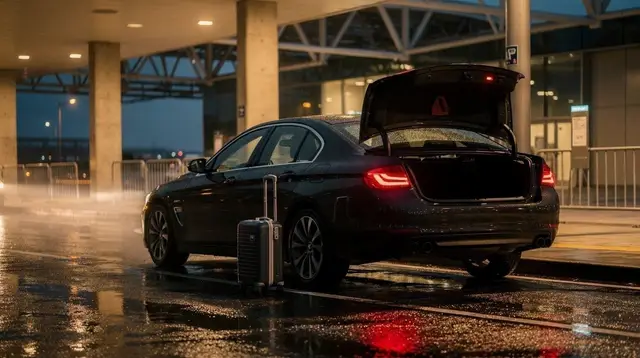
For travellers who want a fixed price without waiting in a taxi line, a pre-booked private transfer is a practical alternative, arranged and paid before you land so there’s no ambiguity about cost. A private limousine transfer from JFK gives you a driver waiting with your name at arrivals, at a fixed price agreed in advance, which suits travellers arriving with heavy luggage, at odd hours, or in a group splitting the cost.
For a deeper dive into JFK specifically — which terminal each airline uses, how the taxi queue is organised, and how the AirTrain fare stacks on top of the subway fare — see our dedicated JFK airport transfer guide. It covers the same ground as this page but with more terminal-level detail for travellers who only need the JFK side of the story.
The AirTrain at JFK: what it actually does, and doesn’t
This is where the most common and costly mistake happens. The AirTrain at JFK is free, but only for travel between the airport’s own terminals — moving from Terminal 4 to Terminal 8, say, or getting from any terminal to the airport’s rental car centre or parking areas. It is an internal airport shuttle, not a link into the city.
To actually reach Manhattan using the AirTrain, you ride it to one of two connection points — Jamaica Station or Howard Beach Station — and from there you must pay a separate fare to continue: a subway ride (via the E, J or Z trains from Jamaica, or the A train from Howard Beach) or the Long Island Rail Road (LIRR) from Jamaica, both requiring their own OMNY tap or MetroCard, in addition to the AirTrain fare you already paid to leave the terminal.
Travellers who assume the AirTrain is a free ride to Manhattan are technically half-right and half-wrong in a way that causes real problems: half-right because the terminal-to-terminal leg is free, and half-wrong because the onward leg into the city is not, and skipping this step means arriving at a fare gate with no ticket and no idea why.
Budget roughly 60 to 90 minutes door to door for the AirTrain-plus-subway route to Midtown, including walking time and waits, and expect to carry your own luggage through stairs and platforms — a real consideration after a long flight.
LaGuardia: no AirTrain, meter-only ground transport
LaGuardia is the geographically closest airport to Manhattan, sitting just across the East River in Queens, but it has no dedicated rail link of its own — no AirTrain, no direct subway line into the terminals. This means every LaGuardia ground transport option, whether taxi, rideshare, or scheduled shuttle bus, runs at a price that reflects the actual traffic on the day, since LaGuardia taxis are metered, not flat-rate.
In practice this means a LaGuardia taxi at rush hour can cost noticeably more than the equivalent trip at 11pm, purely because of time spent idling on the Grand Central Parkway or the Robert F. Kennedy Bridge. A pre-arranged transfer between Midtown and LaGuardia, JFK, or Newark is worth considering here precisely because it locks in a price before you’re at the mercy of traffic conditions, which matters more at LaGuardia than at JFK given the absence of a flat fare.
Public bus connections exist (notably the M60 to Manhattan via Harlem, and local buses to subway stations in Queens), but they are genuinely slow and best reserved for travellers with no luggage and no time pressure. If LaGuardia is your arrival point and you’re curious about the borough it sits in before heading into Manhattan, Queens is worth a look — it’s also home to JFK, so travellers flying in and out of different airports on the same trip end up passing through it twice.
For a closer look at LaGuardia’s specific terminals and ground-transport pickup points, our LaGuardia airport transfer guide covers the details that apply only to this airport.
Newark: across the river, with its own AirTrain caveat
Newark Liberty International Airport is in New Jersey, not New York, which surprises visitors who booked a flight into “New York” without checking which of the three airports they landed at. Reaching Manhattan from Newark means crossing the Hudson River, adding both distance and, often, tunnel traffic to the journey.
Like JFK, Newark taxis run on the meter, not a flat rate, so fares vary with traffic on the New Jersey Turnpike and through the Lincoln or Holland Tunnel. A private transfer removes that uncertainty: a private exclusive ride from Newark to Manhattan is booked at a fixed price and picks you up directly at arrivals, which many travellers find worth the premium after an international flight.
Newark also has its own AirTrain, and the same rule applies: it is free only between terminals and to the airport’s own rail station, not into Manhattan. From the AirTrain’s Newark Liberty International Airport Station stop, you must buy a separate NJ Transit or Amtrak ticket to continue to Newark Penn Station or across into Manhattan’s Penn Station — again, two separate fares for two separate legs, not one free ride the whole way.
Because Newark sits in New Jersey rather than New York City itself, it’s also the most practical airport for travellers combining their trip with a side visit to Newark’s surroundings or continuing on to other parts of the state after landing. Our Newark airport transfer guide goes into more detail on the AirTrain-to-NJ Transit connection specifically, including which trains stop at Newark Penn Station versus continuing into Manhattan.
Comparing your options: time, cost, and predictability
| Mode | From JFK | From LaGuardia | From Newark |
|---|---|---|---|
| Taxi | Flat fare, ~45-75 min | Metered, ~30-60 min | Metered, ~40-70 min |
| Rideshare app | Dynamic pricing | Dynamic pricing | Dynamic pricing |
| AirTrain + transit fare | AirTrain + subway/LIRR fare, ~60-90 min | No AirTrain | AirTrain + NJ Transit/Amtrak fare, ~45-75 min |
| Shared shuttle van | Fixed per-person rate, ~60-90 min | Fixed per-person rate, ~45-75 min | Fixed per-person rate, ~60-90 min |
| Pre-booked private transfer | Fixed price, door to door | Fixed price, door to door | Fixed price, door to door |
Traffic is the biggest variable across every option except the JFK flat-fare taxi and pre-booked private transfers, both of which lock in a price regardless of what the highways are doing. For travellers connecting onward, especially on a tight layover, this predictability matters more than the headline cost.
Which airport should you fly into?
If you’re still choosing flights, the airport you land at can shape your first few hours in the city more than the fare difference between them suggests. JFK’s flat-fare taxi and its rail options make it the most predictable of the three for a first-time visitor who wants to know the transfer cost before booking a flight. LaGuardia is the shortest flight distance-wise from Manhattan but the least predictable on the ground, since there’s no fixed fare and no rail link to fall back on if traffic is bad. Newark works well if your itinerary already includes time in New Jersey or a later leg heading south or west, since it sits on the NJ Transit and Amtrak network rather than New York’s subway map.
None of this should be a dealbreaker on its own — flight price and schedule usually matter more than the airport’s transfer logistics — but if you’re planning a short first-time trip to New York or a longer first visit to the USA built around the city, knowing which airport you’ll land at in advance means you can pre-book the right transfer rather than figuring it out jet-lagged at arrivals.
Time zones and flight connections
New York operates on Eastern Time, which is UTC-5 in winter (Eastern Standard Time) and UTC-4 in summer (Eastern Daylight Time), with the clocks shifting during daylight saving between March and November. If you’re arriving from Europe, Asia, or another US time zone and connecting onward — whether onward by plane, or heading into Manhattan and back out again the same day — always cross-check your connection time against Eastern Time on your itinerary, not your originating city’s zone. This matters especially for early-morning departures out of JFK or Newark, where an underestimated ground-transport time compounded with a time zone miscalculation is a common way to miss a flight.
Getting into the city center once you’ve arrived
However you reach Manhattan, once you’re in, the subway runs 24 hours a day, seven days a week, paid with OMNY contactless tap or a MetroCard, at $2.90 a ride as of 2026. If your hotel isn’t ready or you’re heading straight to dinner, dropping bags at a luggage storage location near Penn Station or Grand Central is a common workaround for an awkward arrival time.
For onward travel beyond the five boroughs — to the Hudson Valley, Long Island, or a day trip to Washington DC — the same logic about flat versus metered fares, and about checking exactly what a “free” transit leg does and doesn’t cover, applies just as much to onward trains and buses as it does to the airport transfer itself.
Beyond the airport transfer: settling in
Once you’ve made it into Manhattan, a good first orientation is a guided overview rather than trying to read a subway map half-asleep after a long flight. A guided night tour of New York City is a popular way to see the skyline lit up on your first evening if your flight lands in the afternoon, and a guided bus tour of Manhattan the next morning is an easy way to get your bearings across Midtown, Lower Manhattan and beyond before committing to the subway on your own.
Before you fly home: the transfer in reverse
Everything above works in reverse for your departure, with one extra wrinkle: airlines generally recommend arriving at the airport two to three hours before an international flight, so the same traffic unpredictability that affects LaGuardia and Newark taxis on the way in can eat into that buffer on the way out. If your flight is early morning, book a private transfer or confirm your rideshare pickup the night before rather than assuming a car will be easy to find at 4am.
If you’re checking out of your hotel with hours to spare before a flight, dropping bags at a luggage storage location in Manhattan lets you fit in a last walk or meal without dragging suitcases through the subway. This matters most for flights out of JFK or Newark, where the ride to the airport is long enough that killing time near your hotel first is usually more pleasant than doing it at the gate.
Frequently asked questions about NYC airport transfers
Is the AirTrain free to Manhattan?
No. The AirTrain is free only for moving between terminals inside JFK or Newark airport. To continue into Manhattan you still need to pay a separate fare: OMNY or MetroCard for the subway from Jamaica or Howard Beach (JFK), or an NJ Transit or Amtrak ticket from Newark Airport’s rail station.
Does JFK have a flat taxi fare to Manhattan?
Yes. Yellow taxis from JFK to anywhere in Manhattan charge a flat, city-set fare, unaffected by traffic. This flat rate applies only to yellow taxis picked up at the official JFK taxi stand, not to rideshare apps, which price the trip dynamically.
Are LaGuardia and Newark taxis also a flat rate?
No. Taxis from LaGuardia and Newark run on the meter, so the fare depends on traffic and route, unlike the fixed rate from JFK. A trip at rush hour can cost noticeably more than the same trip at midnight.
How long does it take to get from JFK to Manhattan?
By taxi or rideshare, allow 45 to 75 minutes depending on traffic and destination, and significantly longer at rush hour. By AirTrain plus subway, budget roughly 60 to 90 minutes door to door, including the walk and the wait for a train.
What time zone is New York in for flight connections?
New York runs on Eastern Time: UTC-5 in winter (EST) and UTC-4 in summer (EDT) during daylight saving, which runs March to November. Always check your connecting flight’s boarding time against Eastern Time, not your departure city’s zone.
Which airport is closest to Manhattan?
LaGuardia is geographically closest, in Queens just across the East River, but has no direct subway or train link, so ground transport time can rival JFK’s. JFK and Newark are both farther but have direct rail options (AirTrain plus subway or LIRR for JFK, AirTrain plus NJ Transit or Amtrak for Newark).
Can I share a taxi or transfer from the airport to save money?
Yes, shared shuttle vans and private transfers booked in advance are available from all three airports and can cost less per person than a solo taxi, especially for groups or when arriving late at night when public transit options thin out. A one-way shared transfer between hotels and Newark Airport is one option worth comparing against a solo taxi fare.
Getting Around
Verified deep-linked GetYourGuide tours. Book through these links and we earn a small commission at no cost to you.
GetYourGuide does not provide a product photo for this activity — the image shows the meeting point, photographed by us.