Off-Broadway Shows: What the Name Actually Means
What does off-Broadway actually mean?
Off-Broadway is a legal and industry classification based on theatre size: houses with fewer than 500 seats. It has nothing to do with artistic quality, location, or how long a show has run — several off-Broadway shows have played for decades.
The one number that defines off-Broadway
Ask most visitors what separates off-Broadway from Broadway and they’ll guess it’s about prestige, or budget, or maybe which side of Times Square a theatre sits on. None of that is right. The distinction is a seat count. A Broadway theatre is one of a specific group of houses, most with 500 seats or more, recognized under long-standing industry and union agreements. An off-Broadway theatre is any professional venue with fewer than 500 seats. That’s the whole rule. It says nothing about how good the writing is, how experienced the cast is, or how long the show has been running.
This matters because the word “off” quietly implies “lesser” to a lot of people who haven’t spent time in New York theatre, and that assumption leads visitors astray in both directions — skipping excellent off-Broadway work because it sounds like a consolation prize, or assuming a small venue automatically means an amateur one. Neither follows from the classification. A show can be intensely polished, professionally cast under Actors’ Equity contracts, and running eight shows a week, and still be off-Broadway purely because its house seats 299 rather than 800.
Below off-Broadway sits a further category, off-off-Broadway, for houses under roughly 100 seats, which is where a lot of New York’s experimental and emerging work happens, often with non-union casts and shoestring budgets. It’s a genuinely different tier in terms of resources and polish. Off-Broadway, in contrast, usually looks and feels like a fully professional production — just staged more intimately.
The three-tier ladder — Broadway, off-Broadway, off-off-Broadway — is worth keeping straight because it changes what you should expect from a ticket. Broadway means union scale production values and a house built for hundreds or thousands of people a night. Off-Broadway means a professional cast and crew, usually under Actors’ Equity contracts, in a room that seats a few hundred at most. Off-off-Broadway means smaller budgets, shorter runs, and a real chance of catching a show or a performer before they’re widely known, but also less consistency night to night.
None of the three is “better” in the abstract — they’re different formats for different kinds of storytelling, and a trip that only visits one tier is only seeing part of what New York theatre does. Families weighing a single big night out sometimes find it easier to start from a curated shortlist of shows rather than the full landscape; a guide to family-friendly Broadway and off-Broadway picks narrows that decision down by age-appropriateness and runtime rather than by prestige.
What the size difference actually feels like in the seat
The practical upside of a sub-500-seat house is proximity. In a Broadway theatre, even a good seat can put you thirty or forty rows from the stage, especially in the mezzanine. In most off-Broadway houses, there simply isn’t a bad seat far from the action — a back row might be fifteen or twenty rows back at most, and many venues wrap seating on three sides of a thrust stage or configure the room so nobody is genuinely distant.
That intimacy shapes the kind of work that gets programmed off-Broadway. Musicals and plays that rely on close audience connection, direct address, minimal sets, or unconventional staging — a cast moving through the aisles, an actor speaking two feet from the front row — tend to land better in these rooms than they would in a 1,500-seat Broadway barn. It’s part of why off-Broadway has a reputation, deserved in this respect, for being more experimental: not because the writing is riskier by definition, but because the format supports risks that don’t survive in a larger, more distant house.
None of this means off-Broadway is uniformly stripped-down or minimalist. Some off-Broadway productions run full sets, live orchestras, and complex staging within their smaller footprint. The category covers a wide range, from bare-bones black-box theatre to lavishly produced immersive shows.
Prices, realistically
| Off-Broadway | Broadway | |
|---|---|---|
| Typical ticket range | $40-100 | $80-300+ |
| Premium/VIP seats | Uncommon, usually capped | Can run well past $300 |
| Discount channels | Show’s own website, occasional rush | TKTS booths, digital lottery, rush |
| Booking window | Days to a couple of weeks usually enough | Weeks to months for hit shows |
The headline comparison — off-Broadway cheaper than Broadway — holds most of the time, but not as a rule you can bank on for every booking. A hit Broadway show at full price will comfortably beat most off-Broadway tickets on cost. But a Broadway seat bought through the TKTS discount booths in Times Square, or won through a show’s digital lottery or rush ticket program, can come in at $50-90 for a seat that would otherwise cost $150 or more — occasionally landing below what a full-price off-Broadway ticket costs for the same night. If your priority is genuinely the lowest price rather than the off-Broadway experience itself, it’s worth checking both markets rather than assuming the category alone settles it.
There’s also no unified discount system for off-Broadway the way TKTS serves Broadway. Off-Broadway productions aren’t part of the Broadway League, so tickets are typically bought directly from each show’s own box office or website. Some individual shows run their own rush or student-discount policies, but there’s no single booth or app that aggregates them the way TKTS does for Broadway.
Where these theatres actually are
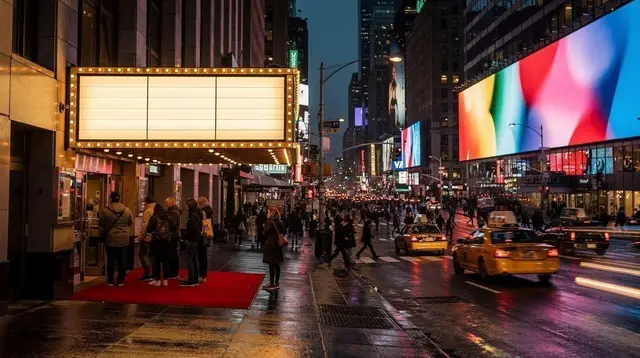
This is the second place the name misleads people. “Off-Broadway” sounds like it should mean “a block or two off Broadway avenue, near Times Square” — and a handful of venues genuinely are near the Theater District. But most off-Broadway houses cluster somewhere else entirely: Greenwich Village, the East Village, and around Union Square, with further pockets elsewhere in Manhattan. Some of the city’s best-known off-Broadway venues have sat in the Village for decades, which is a big part of why the neighborhood has such a strong theatrical identity separate from Midtown’s marquee lights.
If you’re staying near Times Square and picking an off-Broadway show for the evening, budget time for a subway ride or a twenty-to-thirty-minute walk downtown — don’t assume it’s steps from your hotel. Conversely, if you’re already spending an afternoon in the Greenwich Village exploring its streets on a walking tour, checking what’s playing nearby that evening is an easy way to fold theatre into a day you’re already building around downtown Manhattan.
The long-runners that confuse people
New York has a small number of productions that have played continuously for decades, and several of the most famous ones are off-Broadway, not Broadway — a fact that trips up visitors who assume “playing since the 1990s” must mean a big Broadway house. It doesn’t. Longevity and venue classification are unrelated; a show can run for thirty years in a 400-seat off-Broadway theatre and never once become a Broadway show, because the classification never had anything to do with its run length or acclaim. If a show you’ve heard is “legendary” or “iconic” turns out to be off-Broadway rather than Broadway when you look it up, that’s not a downgrade — it’s simply where it has always lived.
Booking, practically
Because there’s no single off-Broadway equivalent of the TKTS booth, plan on visiting each show’s own website directly, well before your trip if there’s a specific one you want. Search availability for your travel dates rather than assuming walk-up tickets will be there, especially for well-reviewed or long-running shows with loyal followings. Some venues offer student or rush tickets at the door, but policies vary show to show and aren’t standardized the way Broadway’s lottery apps are.
If your evening plans are flexible and you’d rather decide once you’re in the city, a trip to the Theater District’s TKTS booth is still worth building into a Broadway-focused night, but it won’t help with off-Broadway listings — check those separately. And if a specific Broadway show is already the priority for your trip, it’s worth reading through a broader box office booking guide before you land, since the buying window and refund policies differ from what a downtown off-Broadway box office will offer:
a full walkthrough of Broadway box office booking, from release dates to refund policy
For visitors who’d rather have someone else assemble the evening — matching a show to the night, handling the booking, and building in dinner around it — a curated off-Broadway package removes the guesswork of picking cold from a list of unfamiliar titles:
a curated off-Broadway show package with ticket and neighborhood recommendations included
Family-friendly off-Broadway picks
Not every off-Broadway show is written for an adult audience, and the smaller-house format actually suits family theatre well: shorter runtimes are common, ticket prices are usually gentler than a full-price Broadway family musical, and the closer seating keeps younger children engaged in a way a distant Broadway balcony seat doesn’t always manage.
A number of long-running off-Broadway productions are built specifically around all-ages audiences, with matinee-heavy schedules that work well around a family’s daytime sightseeing. If you’re traveling with kids and want a shortlist vetted for age-appropriateness rather than scrolling listings blind, a dedicated family-friendly Broadway and off-Broadway shows guide is the faster way to land on something everyone in the group will actually enjoy.
Where to eat before or after
Because the Village theatre cluster sits inside one of Manhattan’s densest and oldest restaurant neighborhoods, the pre- or post-show meal is rarely an afterthought here the way it can be near the chain restaurants ringing Times Square. A Greenwich Village food tour covers a chunk of the same streets an evening of theatre-hopping would, and works equally well as an early-evening warm-up before curtain or a late dinner once the show lets out.
Visitors staying downtown for a few days sometimes combine a show night with a Chinatown and Little Italy food walk earlier in the day, treating the whole stretch — from Little Italy through the Village to Union Square — as one continuous downtown circuit rather than a single-purpose theatre trip.
Making a full night of the neighborhood
Greenwich Village doesn’t empty out when the curtain falls. Its comedy clubs, jazz rooms, and late-night bars have their own long history running parallel to the theatre scene, and several sit close enough to an off-Broadway house to walk to directly from the box office. A stand-up set at the neighborhood’s best-known comedy club pairs naturally with an earlier show, and travelers drawn to the Village’s reputation for the strange and unexplained sometimes swap a second show for a Greenwich Village ghost tour instead, threading the neighborhood’s darker history in between dinner and a nightcap.
Fans of the era when the Village doubled as a film and TV backdrop can also fold in a stop tied to a classic TV show filming-locations tour, since several instantly recognizable exteriors sit within a few blocks of the theatres themselves.
Combining an off-Broadway night with the rest of the city
Because most off-Broadway venues sit downtown, they pair naturally with a day spent around SoHo and Chinatown, a walk through Lower Manhattan, or an afternoon at Central Park before heading south for the evening. Visitors staying in Midtown for the Empire State Building, Times Square, and the classic Broadway houses often treat a downtown off-Broadway show as a deliberate change of pace — smaller room, closer seats, different neighborhood entirely.
For travelers weighing where theatre fits into a broader trip, it’s also worth glancing at a comparison of Broadway ticket strategies so the Broadway-versus-off-Broadway decision is made on price and experience, not on assumptions about which one is “the real thing.” Both are real theatre, staged by professionals, in the same city — just sized differently.
If Broadway itself is more your speed for at least one night of the trip, a guided walk through the Theater District puts the marquees and stage-door history in context:
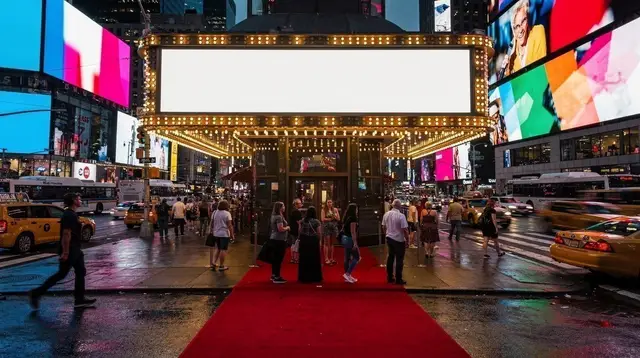
a guided walk through the Theater District’s marquees and stage-door historyFor travelers who want a specific Broadway musical rather than an off-Broadway pick, current long-running hits are easy to book ahead, including a fast-paced retelling of a historical royal court:
tickets to the acclaimed comedy reimagining Mary, Queen of Scots on Broadwayand a modern musical retelling of the Orpheus myth that has become one of the city’s steadiest sellers:
tickets to the Tony-winning musical Hadestown on BroadwayFor something lighter and more comedic in tone, drawing on the recent television series of the same name:
tickets to the musical comedy Schmigadoon! on BroadwayBeyond theatre: rounding out a Village evening
Greenwich Village’s identity isn’t only theatrical. The same streets that host off-Broadway houses are also home to comedy clubs, historic jazz venues, and some of Manhattan’s oldest food and drink institutions, so an off-Broadway evening slots easily into a broader night out. A pre-show dinner in the Village, followed by the performance, followed by a late walk through streets that still carry their pre-grid, colonial-era layout, makes for a full evening without ever needing a subway ride to Midtown.
Travelers building a longer stay around downtown Manhattan might also look at a multi-day itinerary covering Manhattan essentials or a three-day classic New York plan to see where an evening like this fits against museum visits, waterfront walks, and the city’s bigger landmarks.
Off-Broadway, in short
The category exists because of a seating threshold, not a judgment about quality, location, or staying power. Expect closer seats, often lower prices than a full-price Broadway ticket, a genuinely different concentration of neighborhoods — heavily weighted toward Greenwich Village and downtown rather than Times Square — and productions that range from long-running institutions to bold new work. Book directly through each show’s own site, plan your evening around downtown Manhattan rather than the Theater District if that’s where your chosen show sits, and treat the “off” in the name as a description of a theatre’s seat count, nothing more.
Broadway Shows
Verified deep-linked GetYourGuide tours. Book through these links and we earn a small commission at no cost to you.
GetYourGuide does not provide a product photo for this activity — the image shows the meeting point, photographed by us.