Central Park Pedicab: The South Loop Explained
Do you need a pedicab to see the South Loop of Central Park?
No. The South Loop, from Columbus Circle or Grand Army Plaza to landmarks like The Pond and Wollman Rink, covers well under a kilometer and is comfortably walked in 15-20 minutes. A pedicab is a paid, guided option for this stretch, not a requirement — and this small area has the park's heaviest concentration of pedicab and horse-carriage touts.
What “the South Loop” actually means
Central Park doesn’t have official “loops” marked on street signs, but visitors and drivers alike use the term for the bundle of landmarks clustered just inside the park’s southern entrances — the stretch you reach first from Midtown or Times Square, and the stretch where nearly every pedicab and carriage tout in the park is standing, waiting for you.
Two entrances anchor it. Columbus Circle, at the park’s southwest corner, feeds directly into Center Drive and the west side of the loop. Grand Army Plaza, at Fifth Avenue and 59th Street on the southeast corner, feeds into the east side, past the Pond and toward Wollman Rink. Both are a short walk from Midtown hotels and subway stops, which is exactly why this small corner of an 843-acre park absorbs a disproportionate share of its foot traffic — and its solicitation.
This guide covers what’s actually inside that South Loop, how far apart things really are, what a pedicab tour adds to it, and how to handle the touts you’ll meet at both entrances before you’ve gone twenty steps into the park.
What’s inside the South Loop, and how far apart it is
The honest answer to “how big is this area” is: small. Here’s what sits inside a comfortable 15-20 minute walking radius of the two southern entrances.
| Landmark | From Columbus Circle | From Grand Army Plaza | Notes |
|---|---|---|---|
| The Pond | ~350m | ~250m | Small lake just inside the southeast entrances |
| Wollman Rink | ~600m | ~450m | Seasonal ice rink, late October-early spring |
| Center Drive (west side) | Immediate | ~700m | Main paved loop road, closed to cars |
| Sheep Meadow (edge) | ~500m | ~900m | Large lawn, sunbathing and picnics in season |
| The Mall (south end) | ~800m | ~600m | Tree-lined promenade, start of the Central Park walking tour route |
Nothing on that list is more than about 900 meters from either entrance, and the crossing between Columbus Circle and The Pond — the walk most people actually do — comes in under a kilometer. At an ordinary pace, that’s fifteen to twenty minutes, no map required: the paths are paved, well signed, and busy enough that getting meaningfully lost isn’t really possible.
That distance matters because it’s the exact stretch pedicab drivers are pitching rides for. A pedicab covers it in a few minutes rather than fifteen — genuinely faster, but not solving a distance problem that was ever difficult in the first place.
What a pedicab actually adds here
To be direct about it: nothing about the South Loop requires a pedicab, or even meaningfully benefits from one over walking, for anyone reasonably mobile. This is one of the flattest, most heavily paved, best-signed sections of the entire park. It exists inside a fifteen-minute walk of two subway-adjacent entrances. A guidebook that told you otherwise would be selling you something.
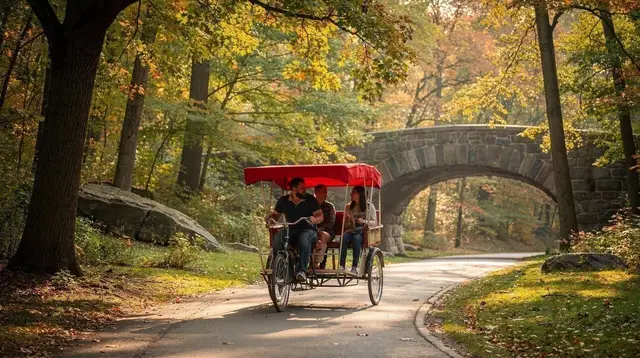
What a pedicab does add is comfort and narration for people who want it: a seat instead of a walk, a driver who can point out Wollman Rink’s ice-skating history or the Tavern on the Green building in passing, and a fixed block of time (usually 30 or 60 minutes) that removes any decision-making about where to go next. That’s a real, legitimate value — for visitors with mobility limits, small children who won’t walk that far happily, or people who simply want a relaxed, narrated ride rather than a self-guided stroll. It is not, however, a way to “see” the South Loop that a healthy walker can’t manage on foot in the same or less time, for free.
If that’s the experience you want, book it as that — a guided ride, not a shortcut — and a Central Park pedicab tour from Midtown that includes a drink is a reasonable way to get a fixed price and a scheduled slot rather than negotiating at the curb. For a shorter, no-frills version of the same idea, a one-hour pedicab tour of the park covers the South Loop and a bit more at a set hourly rate.
The tout density problem, and why it’s concentrated here
Ask anyone who’s worked a New York City tourism job which single spot in Central Park draws the most aggressive solicitation, and Columbus Circle and Grand Army Plaza are the two answers you’ll hear. It isn’t a coincidence. These two entrances sit closest to the hotel-dense blocks of Midtown, get the heaviest first-time-visitor foot traffic in the park, and are close enough to Fifth Avenue and Times Square that a driver can reasonably expect several dozen approachable groups an hour on a good day.
The result is that both entrances host a standing cluster of pedicab drivers and, separately, horse-carriage operators, all competing for the same short window of a visitor’s attention — often calling out prices, sometimes walking alongside you for a few steps making a pitch, occasionally repeating the offer more than once after an initial “no.” None of this is dangerous. Nearly all of it stops the moment you keep walking and don’t engage. But it is a genuinely higher-pressure environment than the rest of the park, where solicitation thins out fast once you’re a few hundred meters past either entrance.
A few practical points worth knowing before you’re standing there:
- A quoted price at the curb is a starting offer, not a fixed rate. Licensed pedicabs are required to display a rate card, usually priced per half-hour or per hour for up to a set number of riders — ask to see it, and ask for the total dollar amount for the specific length of ride you want, not a per-minute figure that’s easy to misjudge.
- “Free” is never actually free. A driver offering a “free tour” or “just come look” is opening a negotiation, not making a gift; the price conversation happens at the end, on their terms, which is worse for you than agreeing to a number up front.
- Repetition is a pressure tactic, not new information. If you’ve said no once, a second or third approach doesn’t require a longer explanation — a flat, polite “no thank you” and continued walking ends it just as well as it did the first time.
- This behavior is not representative of the whole park. Once you’re past the South Loop cluster — heading toward Sheep Meadow, the Mall, or further north — solicitation drops off sharply. It’s a feature of these two entrances specifically, driven by foot traffic, not a park-wide character trait.
None of this is a reason to avoid the South Loop, which remains one of the most rewarding, easily reached corners of the park. It’s simply worth knowing what to expect at the gate before you’re standing in it.
Pedicabs and horse carriages are not the same thing
It’s an easy mix-up, especially with both types of driver often stationed within sight of each other at the same entrances, but pedicabs and horse-drawn carriages are entirely separate activities, regulated under different city rules, with different vehicles, different stands, and different price structures.
A pedicab is a pedal-powered, human-driven cycle rickshaw, typically seating two to three passengers, licensed to operate on the park’s interior drives. A horse-drawn carriage is an animal-drawn vehicle, regulated separately under New York City’s carriage-horse rules, generally departing from designated stands — most visibly along Central Park South near Midtown — rather than roaming the loop roads the way pedicabs do. Carriage rides follow their own fixed routes and pricing structure, distinct from anything a pedicab driver will quote you.
If a carriage ride is what you’re actually after, treat it as its own decision with its own research, separate from anything in this guide — don’t let a curbside pitch conflate the two just because both drivers are standing at the same entrance.
A realistic way to spend an hour or two here
For most visitors arriving from Midtown or Times Square with an hour or two free, the most straightforward version of this visit looks like a short walk, not a booked ride:
- Enter at Columbus Circle or Grand Army Plaza — both are one subway stop or a short walk from most Midtown hotels.
- Walk the roughly 350-600 meters to The Pond, a quiet, low-key spot to get your first real look at the park’s landscaping.
- Continue toward Wollman Rink (in season) or simply follow Center Drive north, which is closed to car traffic and shared by walkers, joggers and cyclists.
- If you have another hour, extend north to The Mall and the start of the Central Park walking tour route, which continues on to Bethesda Terrace and the Central Park Zoo.
That covers the entire South Loop, at no cost beyond your own time, before you’ve spent a dollar or decided whether a pedicab or carriage ride is something you actually want as an experience in its own right — rather than a transportation problem you didn’t have.
If you do want the guided, seated version of that same walk, it’s worth booking rather than negotiating curbside: a Central Park pedicab tour booked online locks in the price and pickup point in advance, and a guided pedicab tour with narration is the better pick if hearing the park’s history matters more to you than simply covering the ground. Either avoids the exact conversation this guide has been describing.
Where the South Loop fits into a longer park visit
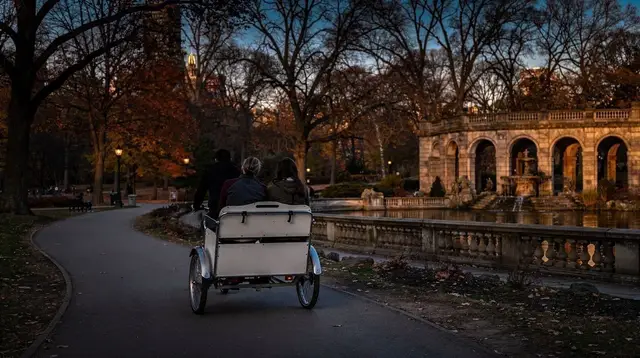
The South Loop is a starting point, not the whole park. If you have more time, it connects naturally north into the Central Park walking tour route through the Mall and Bethesda Terrace, and pedicab operators running longer routes typically extend into the park’s interior well beyond what’s covered here — see the North Woods and Harlem-side pedicab route for a look at what that longer version covers, or the romantic evening pedicab tour if timing a ride around sunset is the goal.
In winter specifically, Wollman Rink is worth its own separate look — see the Central Park winter ice skating guide for hours and ticketing.
For visitors weighing whether any pedicab or carriage ride is worth the money at all, rather than which one, the pedicab scams guide is the more direct read — it covers pricing red flags in more depth than fits here.
Beyond the park itself, the South Loop entrances sit close to several other Midtown landmarks worth folding into the same outing: the Empire State Building observatory, a short cab or subway ride south, or the newer Summit One Vanderbilt observation deck near Grand Central. If Broadway is also on the agenda for the evening, the TKTS discount ticket booth is a few minutes’ walk from either park entrance.
The bottom line
The South Loop of Central Park is compact, flat, well-signed, and entirely walkable in under half an hour from either Columbus Circle or Grand Army Plaza. A pedicab tour is a legitimate, comfortable way to see the same ground for visitors who want a seat and a narrator rather than a walk — it is not a requirement, and no honest guide should tell you it is.
The one real hazard in this corner of the park is the concentration of pedicab and carriage touts at both entrances, whose pitches range from a friendly wave to genuinely persistent follow-up. A polite, firm decline handles it every time; if you do want the ride, book it in advance at a fixed price rather than negotiating on the sidewalk, and remember that pedicabs and horse carriages are two entirely separate activities being sold a few meters apart from each other.
If a fixed-price, pre-booked ride is what you’re after, a one-hour guided pedicab tour of the park is the simplest way to get exactly that, with the price settled before you ever reach Columbus Circle.
Central Park Pedicab & Carriage Rides
Verified deep-linked GetYourGuide tours. Book through these links and we earn a small commission at no cost to you.
GetYourGuide does not provide a product photo for this activity — the image shows the meeting point, photographed by us.