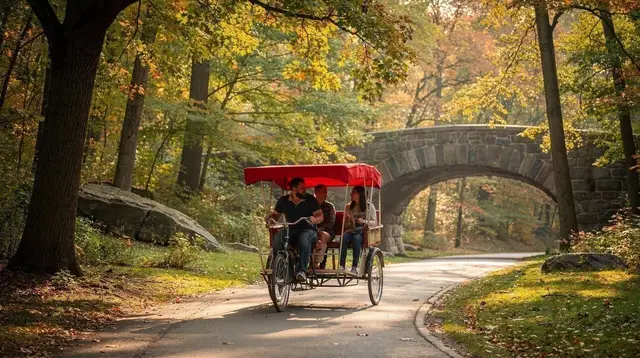
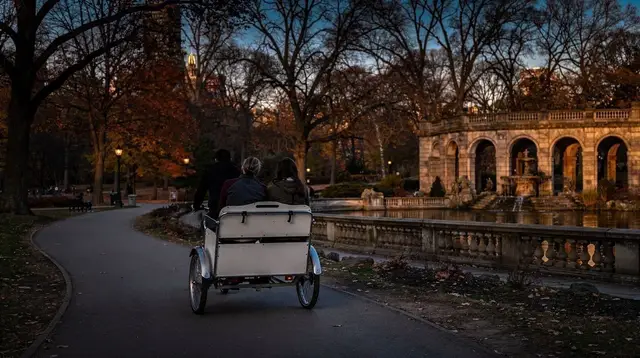
Central Park Pedicab Prices: Avoiding Overcharging and Scams
Are Central Park pedicabs a scam?
Pedicabs are a legal, licensed business in New York City, but overcharging is a well-documented problem near park entrances like Grand Army Plaza and Columbus Circle. There is no single city-set fare, drivers can legally negotiate per ride, and disputes over a final price are common. Confirming the total price before boarding and checking for a visible TLC license plate are the two most effective protections.
Central Park is free to walk into, at any of its many gates, at any hour of the day. No ticket, no turnstile, no admission fee — that single fact is the starting point for understanding why the pedicabs clustered around the park’s busiest entrances have become one of the most consistently reported sources of visitor complaints in New York City. A driver approaching you on the sidewalk near Columbus Circle or Grand Army Plaza is not selling access to something scarce. They’re selling a ride through a public park you could walk into for nothing, and the price of that ride is set by nothing more than what you agree to at the curb.
That’s not a reason to avoid pedicabs altogether — plenty of riders have a perfectly ordinary experience and pay a fair, agreed price for a pleasant loop through the park. It’s a reason to know exactly how the pricing works, where the documented problems come from, and what to check before you get in.
Why there’s no fixed price to fall back on
Unlike a yellow taxi, which runs on a metered fare set by the city, or the subway, which charges a flat $2.90 no matter how far you ride, pedicabs in New York City have no single official rate. There is no per-mile or per-hour figure published by the city that every driver is required to charge. Pedicab operators are legally permitted to negotiate their own price for each ride, and that negotiation happens on the sidewalk, often in the first thirty seconds of a conversation with a visitor who has no idea what a fair number even looks like.
This is the mechanism behind nearly every documented complaint. It isn’t that pedicabs are unregulated or illegal — licensed pedicabs are a legitimate part of the city’s transportation landscape. It’s that the absence of a fixed rate means the same one-hour loop around the park can be quoted at wildly different prices depending on who’s asking, what time of day it is, and how the negotiation goes. A number that sounds reasonable when it’s presented as “per hour” or “for the ride” can turn out, once the ride is over, to mean something else entirely.
The pattern behind most complaints
The scams reported around Central Park pedicabs are rarely about a driver inventing a destination or refusing to move. They’re almost always about the gap between what’s quoted before the ride and what’s demanded after it. A few patterns show up repeatedly in visitor reports and local reporting on the issue:
A rate quoted as hourly, billed as per-ride or per-person. A driver quotes a number that sounds like it covers the whole hour for the pedicab. At the end, the same number is presented as the price per passenger, doubling or tripling the total for a couple or a family who assumed it was one combined fare.
A price that changes mid-route. The initial quote covers a shorter loop than what’s delivered, or the driver takes a longer route and then explains the higher final number as the cost of “the extra distance,” a detour the rider never explicitly agreed to pay more for.
No total agreed before boarding. The conversation at the curb covers a per-block or per-minute rate, or a vague “special price for you,” without ever landing on one total dollar figure for the entire ride. Without that figure fixed in advance, there’s nothing to hold the final bill against.
Drivers without a visible license working the entrances. Licensed pedicabs are required to display a TLC (Taxi and Limousine Commission) license plate. Drivers without a visible plate circulating near the most touristed entrances — Grand Army Plaza at 59th and Fifth, Columbus Circle, the park’s other high-footfall gates — are harder to trace after the fact if a dispute over payment comes up.
None of this means every pedicab near the park is running a scam, and it would be wrong to claim that. It means the structure of the business — no fixed rate, cash or card handled directly with the driver, a captive audience of first-time visitors who don’t know what a fair number is — creates conditions where overcharging happens often enough that it’s worth guarding against on every ride, not just the ones that look obviously wrong.
What to check before you get in
A few concrete steps, done before you sit down, cover almost everything that goes wrong:
Ask for the total price, out loud, before boarding. Not a per-hour rate, not a per-block rate — the full dollar amount for the entire ride you’re describing, start to finish. If the driver won’t give a single total number, that’s the moment to walk away, not the moment to get in and hope it works out.
Confirm whether the price is per person or per pedicab. Say it explicitly: “Is that the total for both of us, or per person?” This single question resolves the most common source of end-of-ride disputes.
Check for a visible TLC license plate on the pedicab itself. A licensed vehicle displays this plate; if you can’t find one, or the driver deflects when you ask about it, treat that as a real warning sign rather than a technicality.
Ask for a receipt. A driver running a legitimate business should be able to provide some form of written confirmation of the price. Refusal to do so, especially paired with a price dispute at the end, is a pattern worth remembering and reporting.
Note the license plate number before you ride. If a dispute does happen, having the vehicle’s registration or TLC plate number is the difference between being able to report the driver and having no way to identify who you rode with.
Decide on the route and stops in advance. If you want to stop for photos at Bethesda Terrace or Bow Bridge, say so before agreeing to a price, and confirm those stops are included in the total rather than billed as extras once you’re already moving.
None of these steps take more than a minute or two, and none of them require confrontation — they’re just the same due diligence you’d apply to any unmetered, cash-negotiated service in an unfamiliar city.
What a guided, pre-booked tour changes
The alternative to negotiating at the curb is booking a pedicab tour in advance, where the price, duration, and route are fixed before you ever meet the driver. A one-hour guided pedicab tour of the park sets the total cost and the itinerary ahead of time, which removes the negotiation entirely — there’s nothing to renegotiate mid-ride because the price was agreed before you arrived. For a shorter introduction with the same structure, a guided pedicab tour through the park’s main sights works the same way: a set price, a set route, agreed in advance.
Pre-booking doesn’t turn a pedicab ride into a bargain — it will typically cost more than a curbside negotiation that goes well, and probably about the same as one that goes badly. What it buys is certainty: you know the number before you show up, there’s a paper trail from the booking itself, and there’s no ambiguity about whether the quoted price is per person or per pedicab. For visitors who’d rather pay a known amount than gamble on a curbside negotiation, that trade is often worth it.
The cheaper ways to see the park
It’s worth restating plainly: Central Park costs nothing to enter, and seeing it doesn’t require a pedicab, a carriage, or any paid vehicle at all.
| Option | Approx. cost | Notes |
|---|---|---|
| Walking | Free | Set your own pace, stop anywhere, no booking needed |
| Citi Bike (bike-share) | A few dollars per ride or a day pass | Unlock via the Citi Bike app at docking stations throughout and around the park |
| Guided pedicab tour (pre-booked) | Fixed in advance | Price and route agreed before the ride; no mid-ride renegotiation |
| Curbside pedicab (negotiated) | Highly variable | No official city rate; price is whatever is agreed at the curb, which is where disputes arise |
Citi Bike, the city’s bike-share network, has docking stations near several park entrances. You unlock a bike through the Citi Bike smartphone app, pay by the single ride or a day pass, and return it to any station when you’re done — a genuinely inexpensive option compared to a negotiated pedicab fare, and one with a transparent, published price rather than a curbside quote. For a walking route that covers the park’s landmark stops at no cost at all, a self-guided approach following the Central Park walking tour hits the same highlights — Bethesda Terrace, the Mall, Bow Bridge — without any vehicle or fare involved.
Comparing the pedicab options
For readers weighing a pedicab ride against walking it themselves, the trade-offs are straightforward: a pedicab covers more ground in less time and takes the physical effort out of a long loop, especially useful for visitors with limited mobility, small children, or a tight schedule between other stops in Midtown. Walking costs nothing, lets you linger exactly where you want, and carries none of the pricing risk described above. A detailed side-by-side sits in Central Park pedicab vs. walking, which weighs cost, time, and comfort for different kinds of visitors.
For those who do want the pedicab experience but prefer a structure with the price locked in, a few pre-booked formats cover different lengths and moods. A one-hour pedicab tour covering the park’s main landmarks suits a first visit with limited time, while a Central Park pedicab tour booked ahead offers the same fixed-price certainty for visitors coming from elsewhere in the city.
Riders wanting a slower, more scenic pace in the park’s northern half might compare this against the dedicated Central Park pedicab, north woods and Harlem route, which covers different ground than the standard south-loop circuit.
If a price dispute happens anyway
If a driver demands more than the agreed total at the end of a ride, the calmest and most effective response is usually to state clearly what was agreed before boarding, ask for a receipt, and note the vehicle’s plate number regardless of how the immediate dispute resolves. Paying under pressure to end an uncomfortable confrontation is common, but it’s also what allows the same pattern to repeat with the next visitor. A licensed operator with a legitimate business has no reason to avoid a receipt or a visible plate; a driver who does avoid both is telling you something useful before you ever get in.
None of this is meant to suggest overcharging is rare or exaggerated — it’s a genuinely common, well-documented complaint specifically clustered around the park’s most touristed entrances, and the absence of any single official city rate is exactly what makes it possible. Whether you walk in for free, unlock a Citi Bike, or book a pedicab tour with the price fixed in advance, the protection is the same: know the total cost before you commit to it, and treat a driver who won’t give you one clearly as a reason to look elsewhere.
Getting to and around Central Park
However you plan to see the park, getting there is straightforward from most of Manhattan. Visitors staying near the Upper West Side or arriving via Midtown can walk to one of the park’s southern entrances in minutes, while those coming from further afield can plan around the Grand Central Terminal area or connect through Columbus Circle itself. For a longer stay that combines the park with other Manhattan highlights, the three-day classic New York itinerary blocks out time for exactly this kind of unhurried park visit alongside the city’s other major sights.
Central Park Pedicab & Carriage Rides
Verified deep-linked GetYourGuide tours. Book through these links and we earn a small commission at no cost to you.
GetYourGuide does not provide a product photo for this activity — the image shows the meeting point, photographed by us.