Central Park Guided Bike Tour: What to Expect
What does a guided bike tour of Central Park actually cover?
A guide leads a small group around roughly 10 km of Central Park's internal loop roads, largely closed to cars, over about 2 hours. Bike and helmet are typically included in the price. The ride stays inside the park; it does not continue onto Manhattan's streets.
Riding Central Park’s car-free loop
Central Park covers 843 acres in the middle of Manhattan, and a large share of its interior is built around a loop road and a network of connecting paths that are closed to car traffic on most of their length. That combination — open pavement, no cars, and a compact circuit — is what makes a guided bike tour work here in a way it simply doesn’t on the streets outside the park. A typical guided bike ride around the park’s main loop covers roughly 10 km (about 6 miles) in around 2 hours, with a guide setting the pace, calling out landmarks, and keeping the group together at intersections and busier stretches.
This guide covers what the ride actually includes, what it costs, who it suits, and — just as importantly — what it does not do. Central Park sits at the center of Manhattan, bordered by the Upper East Side and Midtown, and a bike tour here is one of a handful of ways to see a meaningful slice of the park’s 843 acres without spending a full day on foot.
The route: what’s inside the loop
The park’s main drive forms a loop of roughly 10 km around its perimeter, with additional interior paths, transverse roads, and smaller loops branching off it. Guided tours generally follow some version of this main circuit, adding stops or short detours to landmarks depending on the operator and the season. A rider on flat, paved, mostly car-free road will typically encounter:
- Bethesda Terrace and Fountain, the park’s grand formal centerpiece
- The Central Park Reservoir, a 106-acre body of water with a running track around it
- Belvedere Castle, a Victorian folly with a view over the Great Lawn
- Strawberry Fields, the memorial to John Lennon near the park’s west side
- Assorted bridges, arches, and rock outcrops that give the park its varied, hilly-feeling terrain despite being almost entirely engineered
Because it’s Central Park, none of this is untouched nature — the park was designed from scratch by Frederick Law Olmsted and Calvert Vaux starting in 1858, and its “natural” look, including the rock formations and rolling terrain, was built rather than found. That doesn’t change how it rides: the loop is genuinely pleasant cycling, with gentle grades rather than serious hills, and pavement wide enough for a guided group to move together without constantly stopping for pedestrian traffic, except at the busiest crossing points.
What’s included, and what it costs
Guided Central Park bike tours are typically sold as a single package: bike rental, helmet, and guide are bundled into one ticket, so there’s nothing extra to sort out once you’ve booked. Expect a price in the $30-45 range per person for a roughly 2-hour tour, with some variation by operator, group size, and season. A helmet is either included automatically or available free on request — worth confirming at booking if it matters to you either way.
| What’s typically included | Usually extra |
|---|---|
| Bike rental for the tour duration | Photos taken by the guide (some tours include this, some don’t) |
| Helmet (included or on request) | Extended solo bike rental beyond the tour |
| Guide narration and route | Food or drink stops |
| Small-group riding pace | Tips for the guide (customary, not required) |
Several versions of this tour exist with slightly different framing — a small-group ride through the park’s landmarks, a two-hour guided loop timed to fit neatly into a half-day, and a version built around the park’s film and TV filming locations for anyone who wants the ride framed around a specific theme rather than a general overview. All of them share the same core mechanics: rented bike, helmet, guide, and a route confined to the park’s internal roads.
Who this tour suits
This is a genuinely accessible activity for an occasional cyclist. The park’s loop road is flat to gently rolling, wide, paved, and — on the sections closed to cars — free of the traffic stress that comes with cycling almost anywhere else in Manhattan. You don’t need cycling experience beyond being comfortable riding a standard bike; you do need reasonable balance and the ability to keep pace with a group for around 2 hours, with stops built in along the way.
Families with children old enough to ride independently are common on these tours, and several operators offer smaller bike frames for younger riders — check the specific tour’s age or height minimum before booking, since this varies by company. If you’re planning a broader family day in the city, see the New York City with kids itinerary for how a bike tour might fit alongside other stops.
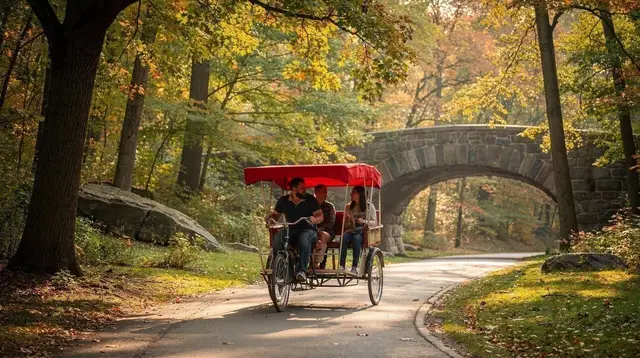
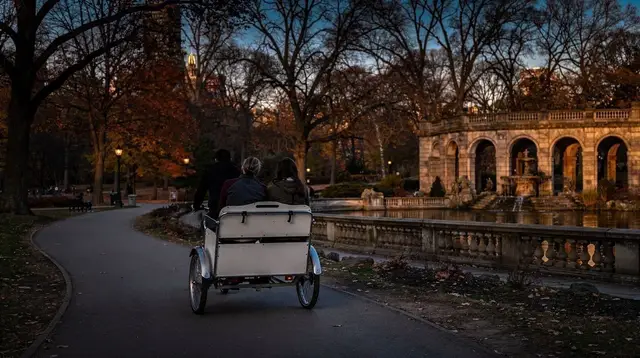
If cycling isn’t your preference but you still want to cover the park’s landmarks at a faster pace than walking, a pedicab compared with walking is worth a look, and the Central Park walking tour covers the same territory on foot, at a slower and more detailed pace, with more time to stop at each landmark.
What this tour is not
It’s worth being direct about the boundaries of a standard guided Central Park bike tour, because the name alone can suggest more than what’s actually offered:
This is not a Manhattan streets bike tour. The ride stays inside Central Park, on its internal loop road and connecting paths — the same roads that are closed to cars on most of their length. It does not continue out through the park’s gates and onto Manhattan’s avenues or cross streets. That’s a deliberate limitation, not an oversight: Manhattan’s streets outside the park carry dense car, taxi, bus, and delivery-truck traffic, and cycling there is a materially different and considerably more demanding activity than riding the park’s protected loop. An occasional cyclist who’s comfortable on Central Park’s car-free road is not automatically ready for Manhattan traffic, and a standard guided tour of this type doesn’t ask that of you.
If what you actually want is a longer, protected ride along the water rather than through city streets, the Hudson River Greenway bike rental guide covers a separate, dedicated waterfront path that runs along Manhattan’s west side — itself car-free, but a distinct route from the park loop and a different kind of ride. A small number of specialty tours combine a Central Park loop with a short, guide-led segment on quieter adjacent streets; if that’s what you’re after, look specifically for a tour description that says so rather than assuming any “Central Park bike tour” includes it.
This is not a self-directed exploration. A guided tour moves at the group’s pace, following the guide’s chosen route and stops. If you’d rather set your own pace and pick your own stops, a self-guided option — renting a bike independently, or following an app-based audio route — gives you that flexibility, without a guide’s narration.
Guided vs. self-guided: which to choose
| Guided tour | Self-guided rental | |
|---|---|---|
| Pace | Set by the guide, group moves together | Entirely your own |
| Landmark narration | Included, live | Not included (unless app-based audio) |
| Route | Fixed by the operator | Your choice |
| Price | Typically $30-45 | Often similar or slightly lower per hour |
| Best for | First-time visitors, families, anyone who wants context | Repeat visitors, those short on time who know the park |
For anyone who wants some structure without a live guide, a self-guided route with app-based audio narration splits the difference — you rent the bike and set your own pace, but still get landmark commentary through your phone as you ride.
Fitting a bike tour into your visit
Two hours is a manageable block to carve out of a day in New York, and Central Park’s central location means a bike tour pairs easily with time in Midtown or the Upper West Side before or after. If you’re planning a single day focused on Manhattan’s core sights, the one-day Manhattan essentials itinerary shows where a bike tour might slot in alongside other landmarks.
For a slightly longer stay that covers more of the city, the three-days classic New York itinerary and two-days Manhattan and Brooklyn itinerary both allow room for an active morning in the park without crowding out everything else.
Morning tours tend to have the calmest paths, before pedestrian and jogger traffic builds up around the reservoir and main lawns. Weekends bring noticeably more foot and bike traffic to the loop road than weekdays, which is worth factoring in if you’d prefer a quieter ride. Spring and autumn offer the most comfortable riding temperatures; for context on what the park looks like at different times of year, see the guides on spring cherry blossoms and fall foliage timing in and around the city.
If you’re weighing a bike tour against the park’s other guided options, a version of the tour that pairs the park loop with a short guided add-on beyond its gates exists for riders specifically looking for more than an in-park route — but confirm exactly what streets are covered before booking, since the core Central Park experience described throughout this guide is the closed-loop ride inside the park itself.
Starting points and what to bring
Most guided tours meet at a rental shop or kiosk near one of the park’s southern or western entrances, close to Midtown and within easy walking distance of Columbus Circle or the streets bordering the Upper West Side. Confirm the exact meeting point when you book, since it’s not always the same address as the operator’s main office — some companies rent from one location and start the ride a few blocks away, inside the park itself. Arriving 10-15 minutes early is enough to get fitted for a bike and helmet before the group sets off together.
What you actually need to bring is minimal, since the tour supplies the bike and helmet. Wear clothes you can pedal comfortably in and closed-toe shoes rather than sandals; bring water, since there are fountains but not always a stop built into the route long enough to buy a drink. Sunscreen matters more than it might seem on a shaded-looking route — long stretches of the loop run along open lawns and the reservoir with little canopy cover. In cooler months, a light jacket that layers off easily is more useful than something bulky, since cycling generates its own warmth even at a gentle pace.
Photos and keepsakes from the ride
A guide can point out where to stop for a photo, but a guide leading a moving group can’t act as a personal photographer for every rider. If capturing the visit well matters more than the ride itself, a dedicated professional photo shoot in Central Park booked separately, on foot, gives you a photographer’s full attention at a handful of chosen landmarks — a different kind of activity from a bike tour, but one that pairs naturally with a visit built around the park’s most photogenic corners. For a shorter, more casual version of the same guided-loop concept without the movie-locations or add-on framing, the base Central Park guided bike tour covers the same core loop, bike, helmet, and guide combination described throughout this guide.
Central Park bike tour FAQ
How long is a Central Park guided bike tour?
Most guided tours run about 2 hours, covering roughly 10 km (6 miles) on the park’s internal loop road and connecting paths, with stops at major landmarks along the way.
How much does it cost to rent a bike for a Central Park tour?
Guided tours with bike rental included typically run $30-45 per person for the tour. Independent bike rental without a guide is usually available at a similar or slightly lower hourly rate from park-adjacent rental shops.
Is a Central Park bike tour safe for someone who doesn’t cycle often?
The park’s main loop and interior paths are wide, mostly flat to gently rolling, and closed to car traffic on most of their length, making them suitable for an occasional cyclist. It is not the same as cycling in Manhattan’s streets.
Does the bike tour leave the park and ride through Manhattan streets?
No. A standard guided Central Park bike tour stays inside the park’s boundaries and its car-free loop road. It does not route through Manhattan’s avenues or cross streets, where traffic is far heavier.
Is a helmet provided on the tour?
Yes, most operators include a helmet with the bike rental or have one available on request at no extra charge. It’s worth confirming at booking if you have a strong preference either way.
What will I actually see on the tour?
A typical route passes Central Park landmarks such as Bethesda Terrace, the Central Park Reservoir, Belvedere Castle, Strawberry Fields, and the park’s bridges and rock outcrops, depending on the specific operator’s route.
Can children join a Central Park bike tour?
Many operators welcome children old enough to ride a standard bike independently and offer smaller bike sizes; check the specific tour’s minimum age and height requirements before booking.
What should I bring on a Central Park bike tour?
Comfortable clothes you can pedal in, closed-toe shoes, water, sunscreen or a light jacket depending on season, and a phone or camera for the landmarks along the route.
Bike Tours
Verified deep-linked GetYourGuide tours. Book through these links and we earn a small commission at no cost to you.
GetYourGuide does not provide a product photo for this activity — the image shows the meeting point, photographed by us.