Stand-Up Comedy Clubs in Midtown and Times Square
How much does a comedy club show in Midtown/Times Square cost?
Entry tickets generally run $20-40 depending on the club and time slot, and most Midtown clubs also charge a drink minimum of one to two beverages at roughly $15-20 each, on top of the ticket. Age minimums are 18 or 21 depending on the venue, and the specific comedians on stage are never guaranteed in advance.
What a night at a Midtown comedy club actually looks like
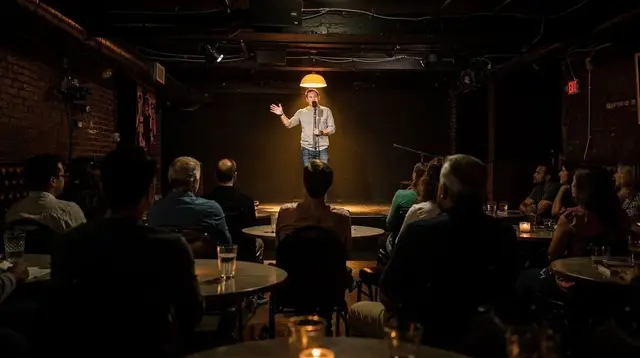
Walk a few blocks off Times Square on almost any evening and you’ll find a cluster of comedy clubs advertising a show starting within the hour. That’s not marketing exaggeration — Midtown’s clubs run multiple sets a night, back to back, because the format is built around turnover: get one audience in, run the show, clear the room, seat the next crowd. Understanding that rhythm is the key to booking a show you’ll actually enjoy, rather than one that surprises you at the door.
A typical Midtown club runs three shows on a weekend night, commonly around 7pm, 9pm and 11pm, with weeknights sometimes trimmed to two. The early show tends to be more polished and broadly accessible; later sets, especially the 11pm slot, lean into edgier, more adult material and a rowdier room. If you’re combining comedy with an early Broadway curtain or want a manageable night, book the earliest slot you can find.
Entry alone doesn’t tell the whole financial story, and that’s where a lot of first-time visitors get caught out.
The real cost: ticket price plus drink minimum
Ticket prices at Midtown and Times Square comedy clubs generally run $20 to $40, varying by club, night of the week and how close to showtime you book — walk-up prices are often higher than advance tickets, and weekend late shows tend to sit at the top of that range.
What catches people off guard is the drink minimum, a near-universal policy at Midtown clubs: you’re required to order one or two drinks per person during the show, priced at roughly $15 to $20 each, on top of the ticket. This isn’t an optional upsell — it’s how many of these venues make their real margin, since ticket revenue alone rarely covers the room, the talent and the staff. A few venues fold a drink or two into a bundled ticket price; most don’t, and the minimum is billed separately at your table.
Here’s a rough sense of what an evening can cost, all-in, for one person:
| Item | Typical cost |
|---|---|
| Show ticket | $20-40 |
| Drink minimum (1-2 drinks) | $15-20 per drink |
| Sales tax (8.875%) | Added to both above |
| Tip on drinks/food (18-20%) | Added on top |
That means a modest night out — one ticket, two required drinks, tax and tip — can land closer to $70-90 per person than the $20-40 the ticket price alone suggests. None of this is hidden exactly, but it’s rarely emphasized in a club’s own marketing, so budget for the drink minimum as a given, not a maybe.
If a club’s page or an Times Square stand-up show ticket doesn’t state whether a drink minimum applies, treat that as a question to resolve before you book — not an assumption that it’s included.
Age limits vary by venue — check before you book
Midtown comedy clubs set their own minimum age, and it isn’t uniform across the neighborhood. Some admit guests 18 and over, treating the room primarily as a comedy venue; others require 21 and over, because they’re licensed and operate as a bar first with comedy as the draw. There’s no citywide standard, so the only reliable approach is checking the specific club and showtime you’re booking — a policy that applies to the 9pm slot might differ from the 11pm slot at the same address if the later show serves alcohol more heavily.
Photo ID is expected regardless of the venue’s stated minimum, and clubs do turn away guests at the door who can’t produce it, ticket or no ticket.
The line-up is real comedians — but never guaranteed in advance
This is the point worth being blunt about: no Midtown comedy club can promise which comedians will be on stage on a given night, and any listing that implies otherwise should be read skeptically. These clubs typically book from a rotating pool of working stand-up comedians — some well-known from television appearances, most building their sets on the New York circuit — and the exact lineup for a specific show is often only finalized hours before curtain. A comedian advertised on a club’s social media for “this week” can be swapped for another act by showtime for reasons entirely outside a booking platform’s control: a scheduling conflict, an illness, a last-minute industry gig.
What you can count on is the format: a house MC, several stand-up sets from working comedians, and a show that runs somewhere between 75 and 90 minutes. What you can’t book in advance is a specific comedian’s face — treat any name attached to a listing as a possibility, not a guarantee, and choose your club based on reputation and format rather than chasing one performer.
If seeing a specific circuit is more the goal than any one comedian, a guided option like the NYC comedy history walking tour with a live stand-up show pairs neighborhood context with a set at the end, which can feel like a more complete evening than a ticket-only booking.
Choosing a club: Times Square versus Greenwich Village
Two broad options tend to come up when people search for stand-up in Manhattan: the tourist-dense clubs clustered around Times Square and Midtown, and the older, scene-rooted rooms further downtown in Greenwich Village, historically the neighborhood where American stand-up as a genre took shape in the mid-20th century.
Midtown clubs are built for convenience: close to hotels, close to Broadway theaters, easy to combine with dinner beforehand. Village clubs trade a bit of that convenience for atmosphere and comedy-scene history, often in smaller, more intimate rooms. Neither is objectively better — it depends on whether your evening is built around Times Square logistics or a dedicated trip downtown.
For a Midtown-anchored night, the Comedy Village Times Square stand-up show ticket sits a short walk from the theater district. For the downtown alternative, the Greenwich Village comedy club stand-up show puts you in the neighborhood where clubs like this trace their roots, and pairs naturally with an evening exploring Greenwich Village on foot beforehand. A simpler, no-frills entry option in the same downtown cluster is the Rodney’s Comedy Club entry ticket.
A third path splits the difference between the two. Some Village clubs blend the downtown setting with a lineup that’s booked roughly as far in advance as Midtown’s rotating pool — meaning the neighborhood changes, but the same rule about not counting on a specific comedian still applies. If the Village atmosphere is the draw more than a particular room, a Greenwich Village comedy evening follows the same booking logic as everything above: confirm the drink policy, confirm the age minimum for your slot, and treat any advertised name as provisional rather than guaranteed.
Booking timing: how far ahead, and which slot
Comedy club tickets don’t sell out with the intensity of a hit Broadway show, but weekend evenings — especially the popular 9pm slot — do fill up, particularly during peak tourist seasons like summer and the December holidays. Booking a few days ahead for a weekend show is a reasonable buffer; for a weeknight, same-day or next-day booking is usually fine.
If you’re building a longer comedy-and-nightlife evening rather than a single show, some clubs bundle formats — for example, the NYC stand-up comedy show with a free round of mini golf pairs a set with a lighter, activity-based add-on, useful if the group includes people who want more than just sitting through a set.
Comedy clubs versus other Times Square evening formats
Stand-up isn’t the only ticketed evening option clustered around Times Square, and it’s worth knowing how it compares before committing a night to it. A Broadway show is a fixed, scripted performance where the cast and material are set for the run — the opposite trade-off from a comedy club, which trades that certainty for spontaneity and a lineup that can change hours before curtain. If budget is what’s deciding between the two, the TKTS discount ticket strategy and the Broadway lottery and rush ticket guide both cover ways to see a show without paying full price, and either pairs easily with an early comedy set the same evening without much extra planning.
Off-Broadway shows split the difference in a different way: smaller houses, often edgier or more experimental material than a mainstream Broadway run, closer in spirit to a comedy club’s intimacy than a large theater. None of this makes one format objectively better than a comedy show — it just means Midtown’s evening options are broader than a single ticket type, and it’s worth deciding what kind of night you actually want, scripted spectacle or live improvisation, before you book.
Groups, first-timers, and special occasions
Comedy clubs handle group bookings routinely. Birthdays, bachelor and bachelorette parties, and larger friend groups are a normal part of a Midtown club’s weekend business, and most venues can seat a group together if you book ahead rather than arriving as separate walk-ups. Being flagged as a celebration group sometimes draws a mention from the MC or a comedian working the room — that’s standard club banter, not something to worry about, though it’s worth deciding in advance whether your group is comfortable with a bit of good-natured audience interaction, since front-row seats increase the odds of it.
First-timers sometimes assume a comedy club works like a movie screening — quiet, anonymous, low interaction — and are surprised when a comedian addresses the room directly or singles out a table. That’s part of the format at most clubs, not a sign of a bad show, and audience participation is generally limited to a few questions rather than anything that puts a guest on the spot for long. If a large, louder group suits your evening better than a quiet couple’s night out, mention the group size when booking, since some venues seat larger parties differently than pairs or solo visitors.
For a broader Times Square evening built around variety rather than a single stop, pairing an early comedy set with a walk through the Times Square lights and attractions afterward is an easy way to stretch one outing into a fuller night without adding a second separate booking.
Pairing comedy with the rest of a Midtown evening
A comedy club show fits naturally into a longer Midtown night. Many visitors combine an early dinner, a walk through Times Square after dark when the signage is at its best, and then a comedy show before or after a Broadway performance depending on which showtime lines up. If the goal is a full night out rather than a single stop, a Times Square/Broadway discount ticket strategy combined with an early comedy slot leaves room for both without rushing either.
For those who’d rather sample the city’s after-dark scene more broadly, an evening built around a speakeasy and Prohibition-era bar crawl offers a different flavor of Manhattan nightlife, and a nightclub and speakeasy walking tour can be combined with an earlier comedy set for a longer night without doubling back across the city.
What to actually expect at the door
Arrive with a valid photo ID even if you look well past any age minimum — it’s standard policy, not a judgment call by staff. Expect a wait to be seated, since clubs turn rooms over quickly between shows and there’s rarely a lounge area built for lingering. Once seated, expect a server to take a drink order fairly quickly if the venue enforces a minimum — this is the moment the minimum gets explained, if it wasn’t already clear at booking, so it’s worth confirming policy details when you buy your ticket rather than being surprised tableside.
Seating is usually first-come within your ticket tier, meaning arriving on the earlier side of the doors-open window generally gets a better table than arriving right at showtime. Phones are typically asked to stay off or silenced during sets — comedians performing live material are sensitive to phone recordings appearing online before a set is refined, and clubs generally enforce a no-recording policy during the show.
Comedy in context: the New York stand-up scene beyond Midtown
Stand-up comedy in New York isn’t confined to Times Square — it’s a citywide institution with roots stretching back to comedy clubs of the mid-20th century, many of them in Greenwich Village. Comedians who built their name on New York stages have gone on to television and film for decades, which is part of why the promise of “you might see someone famous” persists in club marketing — it does happen, on occasion, but it is never something a specific ticket can guarantee for a specific night.
If comedy history interests you as much as the show itself, pairing a night out with a dedicated Comedy History Tour of NYC’s history of comedy adds context most visitors miss when they simply buy a ticket and walk in.
A realistic budget summary before you book
Before booking any Midtown comedy show, it helps to settle three questions in advance: does this club require a drink minimum, what’s the venue’s age policy for your chosen time slot, and which showtime — early, mid-evening or late — fits the rest of your night. None of these are guaranteed to match your assumptions, and none of them are disclosed uniformly across every club’s marketing, so a few minutes of checking before you buy saves an awkward moment at the table.
Budgeting realistically for the ticket, the drink minimum, tax and tip — rather than the ticket price alone — is the single biggest factor in whether a Midtown comedy night feels like good value or a surprise bill. Comedy clubs in this part of Manhattan are genuinely fun, fast-paced evenings when you go in with clear expectations; the frustration cases almost always trace back to an unstated drink minimum or an assumed lineup that didn’t show up.
Nightlife & Comedy Clubs
Verified deep-linked GetYourGuide tours. Book through these links and we earn a small commission at no cost to you.
GetYourGuide does not provide a product photo for this activity — the image shows the meeting point, photographed by us.